


Smart Sailors used to be split into two products, Fleet for maintenance and Crew for the crew. They have been one ever since: a single platform, a single database. The maintenance and fleet operations modules sit in the Premium and Enterprise plans; crew and passengers, the former Crew product, form an add-on you switch on with either.
One binder per vessel, one Excel file per owner, job photos scattered across the crew's phones, and certificates nobody can date precisely. With two or three vessels it holds together. Beyond that, information disperses, deadlines slip by unnoticed, and preparing for an audit turns into a week of work.
The real cost is not the administrative time. It is the vessel held alongside over an expired certificate, the critical spare ordered in a rush at three times its price, and the technical history that walks off with the departing chief engineer.
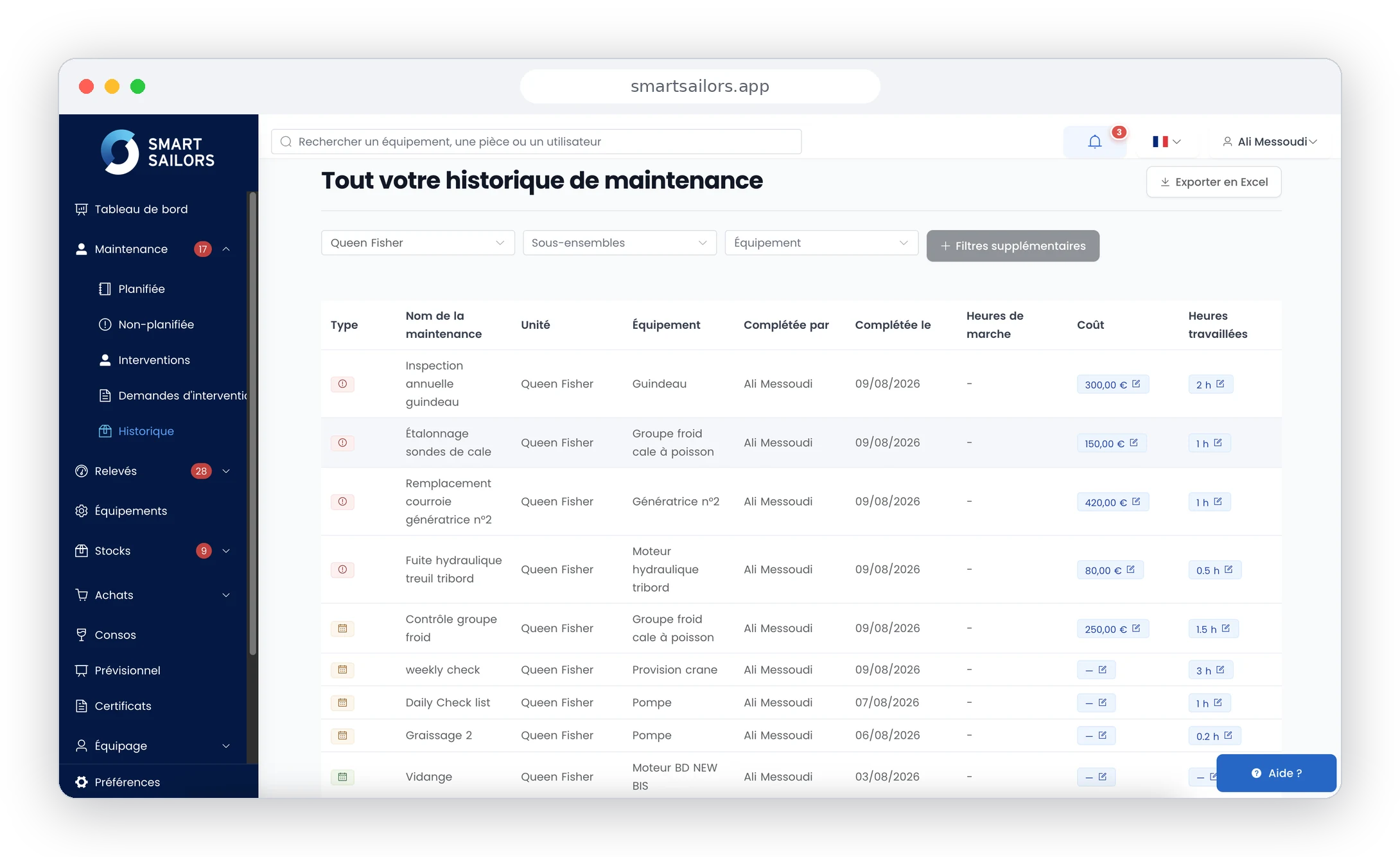
You switch on what you need. The modules share one database: equipment created in Maintenance appears in Inventory, a job consumes a spare, an expiring certificate raises an alert.
Maintenance
Planned maintenance schedules, work orders, history by equipment
Equipment
Technical catalogue of the fleet, manufacturer documentation, criticality
Certificates
Vessel and crew certificates, expiry alerts, audit file
Counters
Running hours, cycles, distances — tasks triggered automatically
Inventory
Spare parts by vessel, alert thresholds, stock valuation
Purchasing
Requisitions, purchase orders, goods receipt, supplier tracking
Crew
Profiles, contracts, STCW certificates, sign-on records, MLC compliance
Team
Roles and permissions, separate access for ship and shore
Passengers
Passenger lists, IMO FAL Form 6 manifests, safety on board
Tanks
Fuel, oil, water — levels, consumption, thresholds
Dashboard
Real-time fleet view, indicators, alerts
Forecast
Forecast spending, consumption and spare parts requirements
A job carried out at sea has to be recorded when it happens, not three weeks later from memory in port. The mobile app records on board and syncs the moment the link comes back. That is what separates a reliable history from a register reconstructed the night before an audit — and an experienced auditor tells the difference in three questions.
ISM Code, SOLAS, MARPOL, MLC 2006, STCW, classification surveys, port State control. Chapters 9, 10 and 11 of the ISM Code require a continuous record of maintenance, non-conformities and documentation: Smart Sailors produces that record automatically, from the work actually carried out.
Understand what the ISM Code requires →Smart Sailors was born in Marseille in 2016, inside a shipping company, because the tools available were built for the factory floor rather than for the ship. Our teams come from the deck and the engine room. That is why crews are up and running in hours rather than weeks.
Our story →Fishing fleets — vessel availability, controlled upkeep costs, certificates in order before every campaign.
Ferries and passenger vessels — tight rotations, IMO manifests, maintenance planned between two port calls.
Shipping and maritime logistics — multi-vessel fleets, ISM compliance, preparation for PSC inspections.
Yachts and superyachts — exacting standards of finish, full traceability, crew management.
Service vessels — offshore wind, towage, marine works.
From owners running a handful of units to fleets of several dozen vessels, across France, West Africa and North Africa. Deployment is supported by our teams: importing your equipment register, building the maintenance plan, training the crew.
Read customer stories →Three plans depending on the size and use of your fleet, from €10 to €150 excl. VAT per vessel per month, plus a Crew & Passengers add-on at €50 excl. VAT. Thirty-day free trial on every plan, no credit card, and your data stays exportable at any time.
See the plans in detail →A CMMS — computerised maintenance management system — centralises the maintenance plan, work orders, job history and spare parts stock. Its maritime form adds what the sector requires in its own right: offline operation, multi-vessel management, tracking of statutory certificates, and the production of the evidence expected during ISM audits and classification surveys.
An industrial CMMS assumes a fixed site and a permanent connection. A ship is mobile, often out of coverage, subject to international regulation and to frequent crew changes. Smart Sailors is built around those constraints rather than treating them as exceptions.
Yes. The mobile app records jobs, fault reports and counter readings without a network: entries are queued on the device, with a visible sync indicator, and sent automatically as soon as a connection is available. Photos are attached to the job once the network is back. Everything about the mobile app.
Directly. The planned maintenance system answers chapter 10, the non-conformity register answers chapter 9, and versioned technical documentation answers chapter 11. Audit reports can be extracted by vessel, by equipment or by period.
It depends on the state of your existing data. A first vessel goes live quickly; importing a complete equipment register and building a detailed maintenance plan takes longer. Our teams support that phase — it is not left to you alone.
It belongs to you and stays exportable at any time, in standard formats. No lock-in.
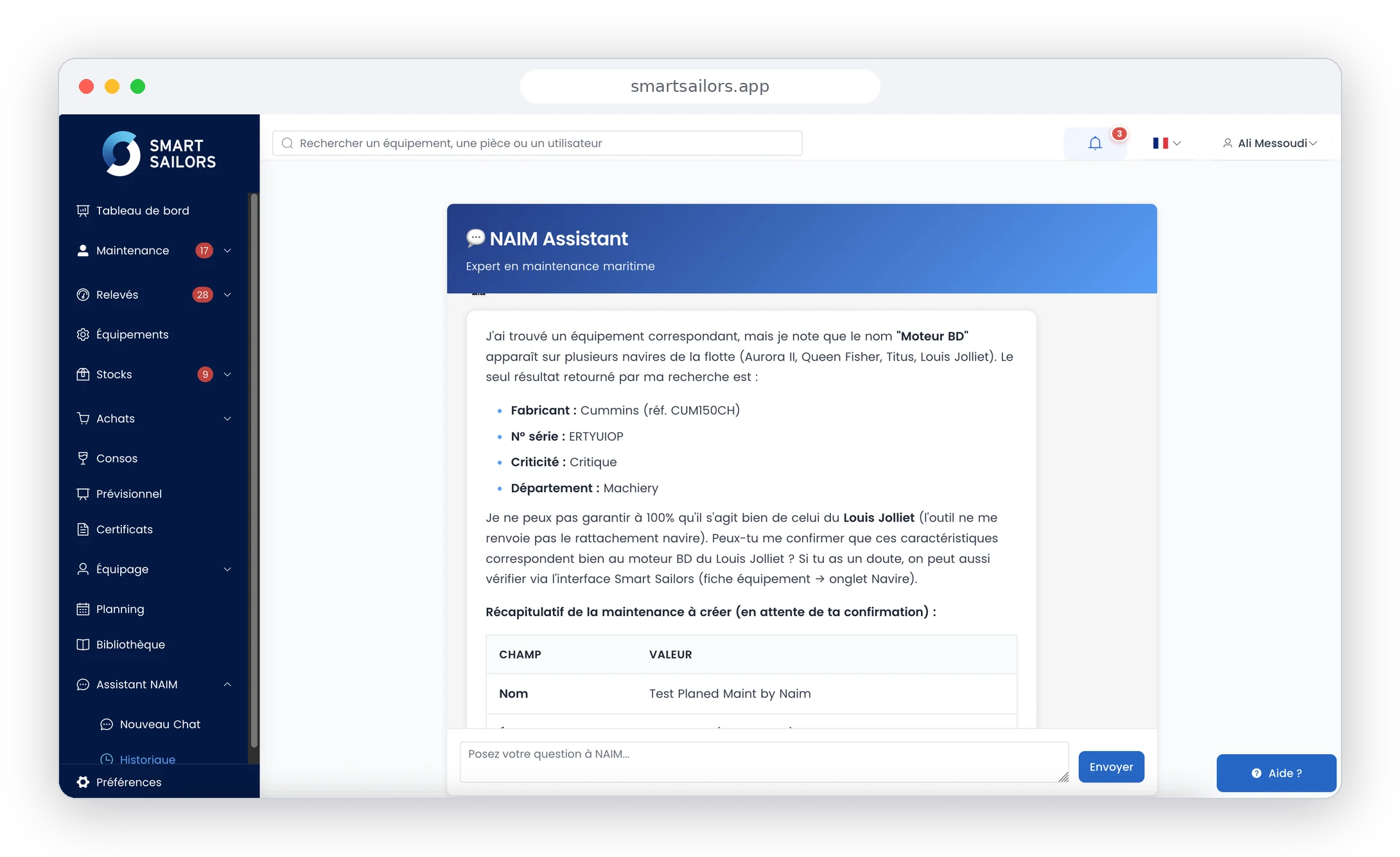
Ask your question in plain language: NAIM identifies the equipment in your fleet, draws on your technical documentation and prepares the maintenance — all that's left is to confirm.
The ship's logbook
Mandatory beyond 6 miles from shelter: what to record, hour by hour
The ISM Code explained
Definition, DOC and SMC, and the chapters 9, 10 and 11 that fail most audits
The planned maintenance system
The four-step method: ABC criticality, intervals, scheduling, KPIs
The maritime glossary
87 French terms defined, with their English and German equivalents
A thirty-minute demonstration, on your actual vessels and equipment, is enough to tell whether the tool fits your operation. No commitment.


.png)

.jpeg)
.png)

.png)




.png)


