

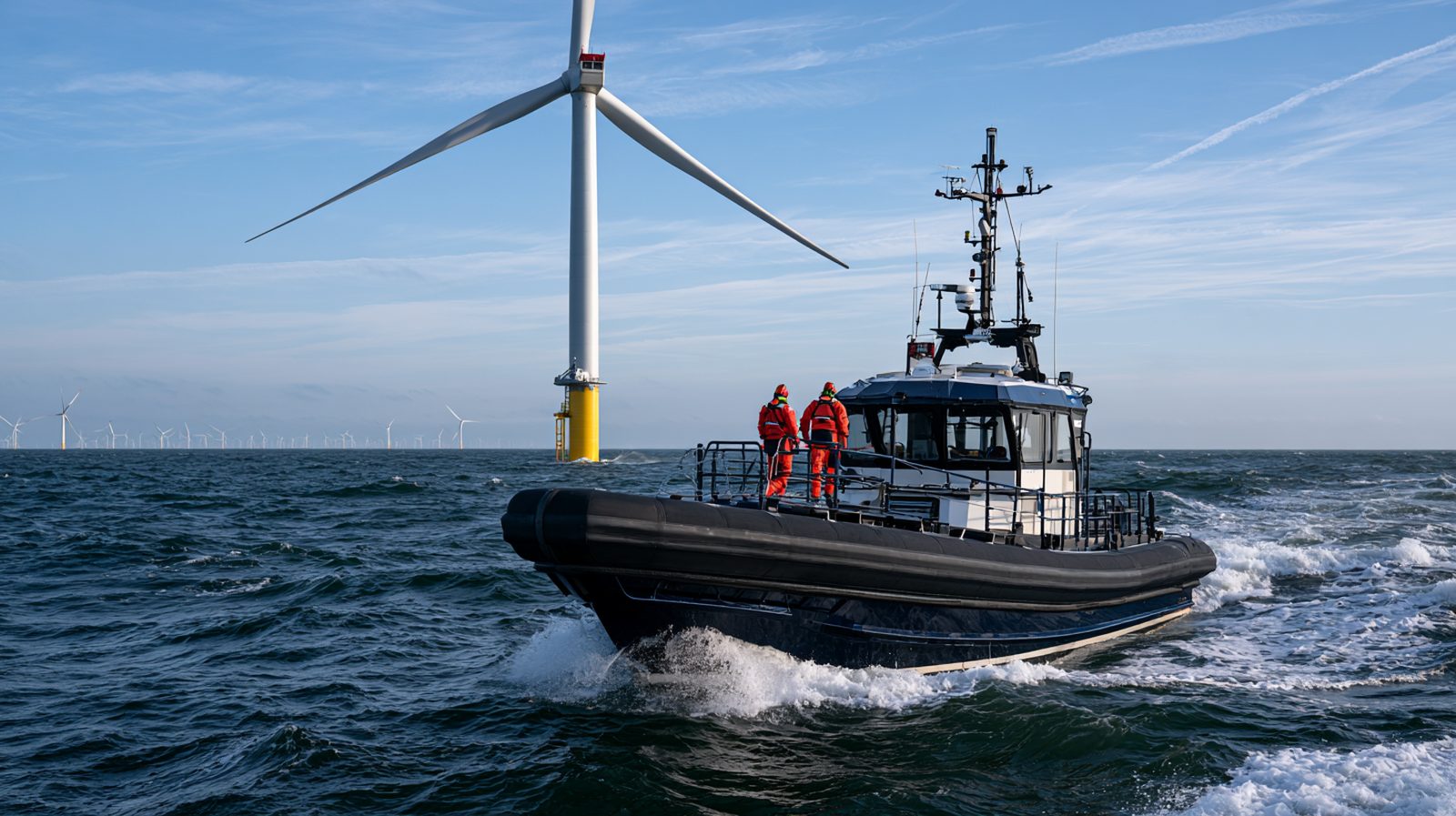


In offshore wind, a support vessel is not a standalone asset. It is the link that decides whether a technician climbs into a turbine on any given morning. A CTV (crew transfer vessel) alongside with a propulsion defect means twelve technicians left ashore, turbines producing below potential, and a penalty line opening in an O&M contract. Offshore wind vessel maintenance is therefore never a purely technical subject: it is a contractual and financial one.
Owners operating CTVs and SOVs (service operation vessels) know it: they sell availability, not transport. Their clients — developers, wind farm operators, turbine OEMs — measure that availability, compare it against signed commitments and audit it. A vessel can be immaculately maintained and still score badly, simply because the owner cannot produce evidence of what was done.
This article sets out what genuinely separates support vessel maintenance from that of a conventional cargo ship: the duty cycle, the components that suffer, how work is organised around weather windows, the traceability charterers expect, and the indicators you need to be able to produce — with, at each step, what a properly configured planned maintenance system changes on board.
A business model where availability is invoiced
An offshore wind O&M contract rests on a simple promise: the operator commits to a turbine availability figure. To keep it, technicians must reach the machines as soon as a weather window opens. The vessel is the tool that delivers that access, and that is how it enters the contractual chain.
The vessel as one link in a chain of commitments
CTV and SOV charters are usually time charters with performance undertakings attached: a minimum technical availability expressed as a percentage of contract days, a precise definition of off-hire, and often operational criteria — transfers completed, adherence to departure times, ability to operate up to a stated significant wave height.
Every hour of unplanned downtime therefore converts into money: hire suspension, liquidated damages, or both. A planned stoppage, notified within the agreed notice period and executed inside the agreed window, is normally neutral. The difference is not the failure itself — it is anticipation.
The cost of unavailability in practice
On a CTV, a defect discovered at 05:30 before departure often costs the whole day: the window is short and a substitute vessel is rarely instant. On an SOV, where the day rate is an order of magnitude higher, an unavailable motion-compensated gangway makes the vessel inoperable even though propulsion, power generation and accommodation are all working perfectly. The functional unit being sold is not the vessel: it is the ability to transfer people safely.
That logic must reach the maintenance plan. Equipment whose failure stops transfers is contractually critical, even if it carries no special status under class rules. It is worth revisiting equipment criticality against the charter, not only against the regulatory framework.
What wears a CTV or SOV faster than a conventional ship
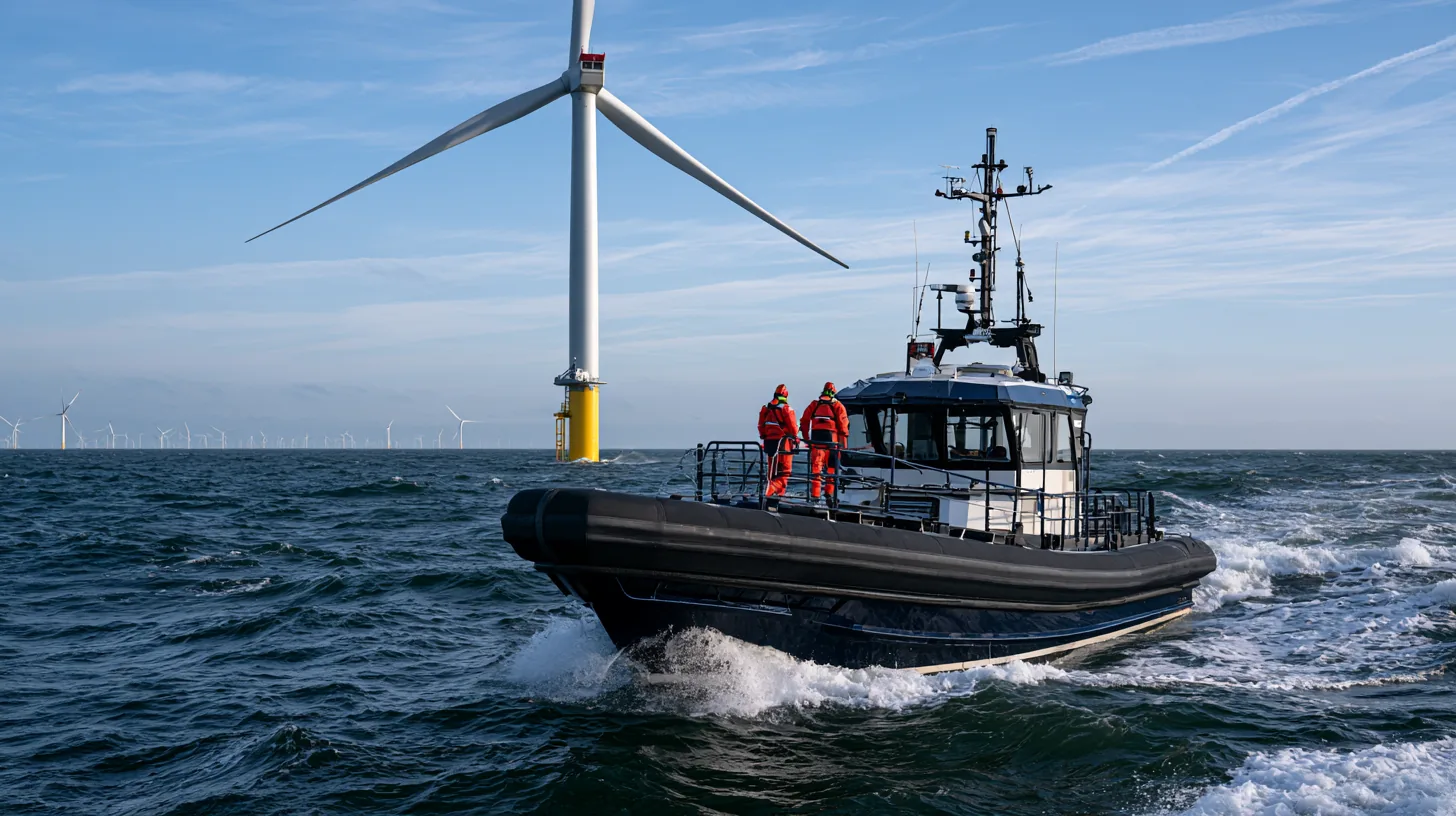
The duty cycle of an offshore wind support vessel has no equivalent in conventional merchant shipping: high running hours, repeated mechanical shock loading, and permanent exposure to a developed sea state.
Bumper transfer and structural fatigue
The bumper transfer — pushing onto the foundation boat landing with engines holding the vessel in place — is the defining manoeuvre of a CTV. Repeated several dozen times a working day, it concentrates impact and cyclic loading into a few zones: the transfer bow, fenders and their fixings, forward reinforcement. Across a season, that means thousands of cycles.
The consequences are familiar to chief engineers in this segment: fender wear and delamination, cracking at stiffener ends, slack in bolted assemblies, coating breakdown in the contact area. None is dramatic in isolation; all become blocking if they escape detection, because a degraded transfer bow is grounds for an immediate stop on the client side.
A calendar-only response will not work. It requires frequent, structured and recorded visual inspections, indexed to the number of transfers rather than the number of days — a task driven by a usage counter, not by a date.
Propulsion under constant load
CTVs alternate full power in transit, low-speed manoeuvring and sustained static thrust against the foundation. That profile is punishing for shaft lines, gearboxes, bearings and waterjets. On a vessel working from a fixed base, several thousand running hours per engine per year is not unusual, which compresses the intervals between major overhauls.
Recurring watch points: oil analysis, flexible couplings, shaft line vibration, cooler fouling, corrosion at hull penetrations and — routinely underestimated — fuel quality and filtration under highly variable load. Periodic readings with thresholds and a visible history beat one exhaustive annual check.
Compensated gangways, DP and transfer systems
On SOVs and CSOVs, transfer is made through a motion-compensated gangway, often combined with a personnel lift and a cargo transfer crane. These systems combine high-pressure hydraulics, actuators, motion sensors, PLCs and compensation software. They require dedicated inspections, functional testing and documented compliance with operating limits: sea state, angles, loads.
Most of these vessels also carry dynamic positioning, with the annual trials, redundancy requirements and reporting that come with it. A fault on a position reference, a thruster or a power chain does not always show up as a visible breakdown: it shows up as lost DP capability, and therefore an inability to operate.
A high HSE bar
Offshore wind clients often come from the energy sector rather than from shipping. They import strict HSE standards: energy isolation before work, permits to work, electrical and working-at-height authorisations, systematic near-miss reporting. Maintenance carried out without a traceable isolation record is, to them, a non-conformity regardless of its technical quality. The link between safety, lockout-tagout and job recording becomes a contractual expectation.
Organising maintenance around weather windows
This is the most disconcerting point for a superintendent arriving from another segment: on these vessels, the maintenance calendar does not command, it adapts.
Bad weather as a maintenance resource
When the sea state exceeds transfer limits, the vessel produces no operational value. Those days are the most valuable maintenance resource of the year, and they cannot be scheduled far in advance. The winning setup keeps a permanent ready-to-execute task list: parts on board, procedure written, duration estimated, and launchable at a few hours' notice.
That requires reliable visibility of what is genuinely available on board — hence the importance of inventory management and of preventing critical spare shortages. It also requires clear prioritisation: when the window is eight hours long, the crew must be able to identify the top three jobs in thirty seconds.
Crew rotations and information continuity
CTVs run short rotations; SOVs run long rotations with marine crew and client technicians on board. In both cases, the person who spots a defect is almost never the one who will fix it. Without a common system, the information dies in a notebook or a handover conversation.
The remedy is well known but rarely applied properly: any observed defect immediately becomes a time-stamped work request linked to the equipment concerned, visible to the next team and to the superintendent ashore. Turning an individual observation into shared data is the first function of a maintenance plan that is actually kept up to date.
Critical equipment: what to watch first
These are the systems that decide whether the vessel can operate, and that deserve enhanced monitoring:
- Forward transfer structure: fenders, fixings, reinforcement, coatings — inspection indexed to transfer count, with dated photographs.
- Main propulsion: engines, gearboxes, shaft lines, waterjets — temperatures, vibration, oil analysis, running hours.
- Compensated gangway and personnel lift: functional tests, hydraulics, motion sensors, emergency stops.
- Dynamic positioning: thrusters, position references, gyros, power supply, annual trials and DP incident log.
- Power generation and distribution: gensets, switchboards, insulation, load management — critical on SOVs.
- Lifting appliances: transfer crane, hoists, slings — statutory examinations and valid certificates.
- Life-saving and firefighting appliances: liferafts, EPIRB, fire detection and extinguishing, man-overboard recovery.
- Navigation and communication: radar, AIS, GNSS, VHF, transfer tracking systems.
- Fluid systems: bunkers, ballast, sewage and fresh water, with readings usable for environmental compliance.
Traceability: what the client will ask for
This is where offshore wind differs most from other segments. The charterer is not satisfied by a vessel that simply works: they require documented evidence that maintenance is done, that certificates are valid and that the people on board are qualified. Charter audits, fleet inspections and performance reviews scrutinise the records as much as the hardware.
An owner who produces these items within hours builds confidence; one who takes two weeks to reconstruct a history looks like an owner who does not control the vessel. The table below links the most frequent requests to the data you need to produce.
| Client / auditor requirement | Data to produce | Source in the PMS |
|---|---|---|
| Prove planned maintenance is up to date | Task completion rate, list of overdue jobs with justification | Maintenance module — maintenance plan and closed work orders |
| Full history of a critical item | Job timeline, parts fitted, running hours, failures | Equipment module — equipment record and linked history |
| Validity of statutory certificates and class surveys | Certificate list with expiry dates and alerts | Certificates module — expiry schedule and attachments |
| Qualifications and certificates of competency on board | Crew matrix, licences, medicals, expiry dates | Crew module — individual files and expiry alerts |
| Job report after a failure or incident | Dated report, cause, corrective action, photographs, signature | Maintenance module — work order with mobile attachments |
| Justify the month's technical availability | Downtime hours by cause, planned and unplanned | Dashboard module — consolidated indicators per vessel |
| Demonstrate critical spares are on board | Stock levels, minimum thresholds, movements and consumption | Inventory module — per-vessel stock and threshold alerts |
| Traceability of orders and supplier lead times | Requisitions, purchase orders, promised and actual dates | Purchasing module — requisition to order to receipt |
The principle never changes: data is captured once, at the moment of the job, by the person performing it. Any later reconstruction is expensive and fragile under audit — which is exactly what the ISM Code applied to maintenance requires, and its record-keeping obligations overlap heavily with what wind clients ask for.
Spares and lead times in a tight market
Rapid sector growth has a very real side effect: lead times have stretched on certain component families — gangway hydraulics, control electronics, propulsion parts, waterjet-specific items. Several weeks of waiting on a critical component turns a one-day repair into extended downtime.
Three practices limit the risk without tying up cash:
- Separate critical stock from comfort stock. Critical stock is defined by the consequence of a shortage — lost transfers, lost DP capability, lost propulsion — not by the price of the part.
- Pool at fleet level. Where several vessels share a port base, one well-managed shore store beats duplicated on-board stocks that are invisible to each other.
- Measure real supplier lead times. Comparing promised and actual dates over twelve months changes replenishment decisions — provided the purchasing cycle lives in the system rather than in an inbox.
For remote bases, the principles set out in managing spare parts at sea apply directly to the wind segment.
The contractual KPIs you must be able to produce
Monthly performance reviews always revolve around the same indicators. Better to build them yourself than to discover them in the charterer's spreadsheet.
Technical availability
The share of contract days or hours during which the vessel was fit to operate. The sensitive part is not the arithmetic but the attribution of causes: weather, client decision and vessel defect carry very different contractual consequences. Without time-stamping and categorisation at source, the discussion runs on memory.
Transfer success rate
Completed transfers against scheduled transfers. The indicator blends weather, crew competence and equipment condition. Isolating the equipment-related share — gangway down, fender damaged, propulsion degraded — is what allows an owner to show the vessel is doing its job when the weather is not.
Mean time to restore service
The time between detecting a defect and returning to operational status. It is the most revealing indicator of an organisation: it aggregates detection speed, spares availability, procedure quality and ship-shore coordination. Reducing it rarely means more people; it almost always means less waiting and less searching for information.
Plan health indicators
Preventive completion rate, backlog volume, share of corrective work in total workload. A rising corrective share signals drift, often months before it turns into off-hire. Moving from corrective to condition-based maintenance suits these hard-worked vessels particularly well.
What a fit-for-purpose PMS changes
Software replaces neither a chief engineer nor an inspection. It does eliminate three recurring losses: information not passed at handover, work done but not evidenced, and parts ordered too late.
Offline mobile capture
This is the decisive feature on a CTV. Inside a wind farm, network coverage is unreliable, and machinery spaces are never covered. A mobile app that works without a connection and syncs on return alongside lets the crew close a work order, photograph a damaged fender or log a reading at the moment of the job. What is not captured then is captured approximately, or not at all.
Fleet-level oversight
An owner running several vessels across several wind farms needs comparison: which vessel consumes the most fender parts, where preventive backlog builds up, which base suffers the worst supplier lead times. An automatically populated fleet dashboard replaces manual spreadsheet consolidation, which always arrives too late to act on.
Statutory and contractual expiries
Flag State and class certificates, lifting appliance examinations, annual DP trials, certificates of competency and seafarer medicals: these belong in a single expiry schedule with advance alerts. It is a scope checked in every charter audit, and one of the easiest to secure.
Key takeaways — On a CTV or an SOV, maintenance does not only protect the vessel: it protects the day rate. Three habits structure everything else. Index critical inspections to actual usage — transfers, running hours — rather than to the calendar. Keep a permanent ready-to-execute task list so bad weather windows become productive. Capture every job as it happens, on mobile and offline, so the evidence exists before the client asks for it.
FAQ
What is the main difference between CTV and SOV maintenance?
A CTV is a fast, lightly crewed vessel whose weak points are the forward transfer structure and propulsion, loaded by dozens of daily boat landings. On an SOV, criticality shifts to the compensated gangway, dynamic positioning, power generation and lifting appliances. A CTV is largely maintained alongside; an SOV is maintained on board, continuously, with an embarked technical team.
How do you plan maintenance when the weather sets the calendar?
By inverting the logic: instead of planning a date, you prepare a state of readiness. Every job needs its parts on board, its written procedure and an estimated duration, so it can start as soon as a non-workable window appears. A planned maintenance system that ranks ready-to-execute tasks turns a bad weather day into a productive one.
Which documents do wind charterers ask for most often?
In order of frequency: preventive maintenance plan status, job history for critical equipment, statutory certificates with expiry dates, the crew qualification matrix, and job reports following failures or incidents. These are requested before fixture, then reviewed periodically during the charter.
Does a small fleet of two or three CTVs really need a PMS?
Yes, often more than a large one. A small operator has no dedicated technical department: the same person handles operations, purchasing and compliance. That is precisely where a system centralising expiries, stock and history frees up time. Per-vessel monthly pricing and a 30-day free trial let you test it without heavy commitment.
How do you demonstrate that downtime is not the owner's fault?
By time-stamping and categorising every stoppage as it happens: weather, client decision, technical defect, waiting on parts, planned work. Recorded live in the system, that attribution is very hard to challenge. Rebuilt three weeks later from messages, it carries no weight against the charterer's own log.
Should maintenance be counter-driven on these vessels?
Strongly recommended. Engine hours, generator hours, gangway cycles and transfer counts are the real maintenance triggers here. Driving the plan from those counters rather than from the calendar avoids both over-maintenance in the low season and under-maintenance at peak.
Conclusion
In offshore wind, an owner's performance is decided as much in the engine room as in the ability to document what happens there. The vessels are worked harder than average, intervention windows are dictated by the sea, and clients expect continuous evidence. Maintenance driven by actual usage, executed in weather downtime and recorded at the moment of the job: that combination is what protects contractual availability.
Smart Sailors is a maritime PMS designed by seafarers, deployed on more than 700 vessels, with an offline-capable mobile app and consolidated fleet reporting. To see how it applies to your CTVs or SOVs, book a demo or start a 30-day free trial.
The management principles set out here apply to other service fleets, as the maritime CMMS guide shows.


.png)


