



What actually travels on the NMEA 2000 bus
On a properly fitted vessel, main engine coolant temperature, oil pressure, running hours, tank levels and battery voltage are already moving around the boat every second of the day. They travel on the NMEA 2000 bus and they appear on a multifunction display in the wheelhouse. Most of the time, that is where they stop.
Nobody records them. Nobody compares them with last week's figures. The engineer writes the hour counter down by hand, copies it into a spreadsheet when the vessel is alongside, and the oil change is triggered off that copied number. The accurate figure was on board all along. It simply never reached the maintenance plan.
This article is about closing that gap: what the bus really carries, what you can do with it for maintenance, and — just as important — where the approach works and where it does not.
A CAN bus, a backbone and T-connectors
NMEA 2000, usually shortened to N2K, is a marine communication standard published by the National Marine Electronics Association. It is built on the CAN bus (Controller Area Network), the same differential serial network principle the automotive and heavy truck industries have used for decades. The appeal of CAN on board is simple: a twisted pair, a power supply, a screen, and any device connected to it can both transmit and listen without a central controller having to arbitrate.
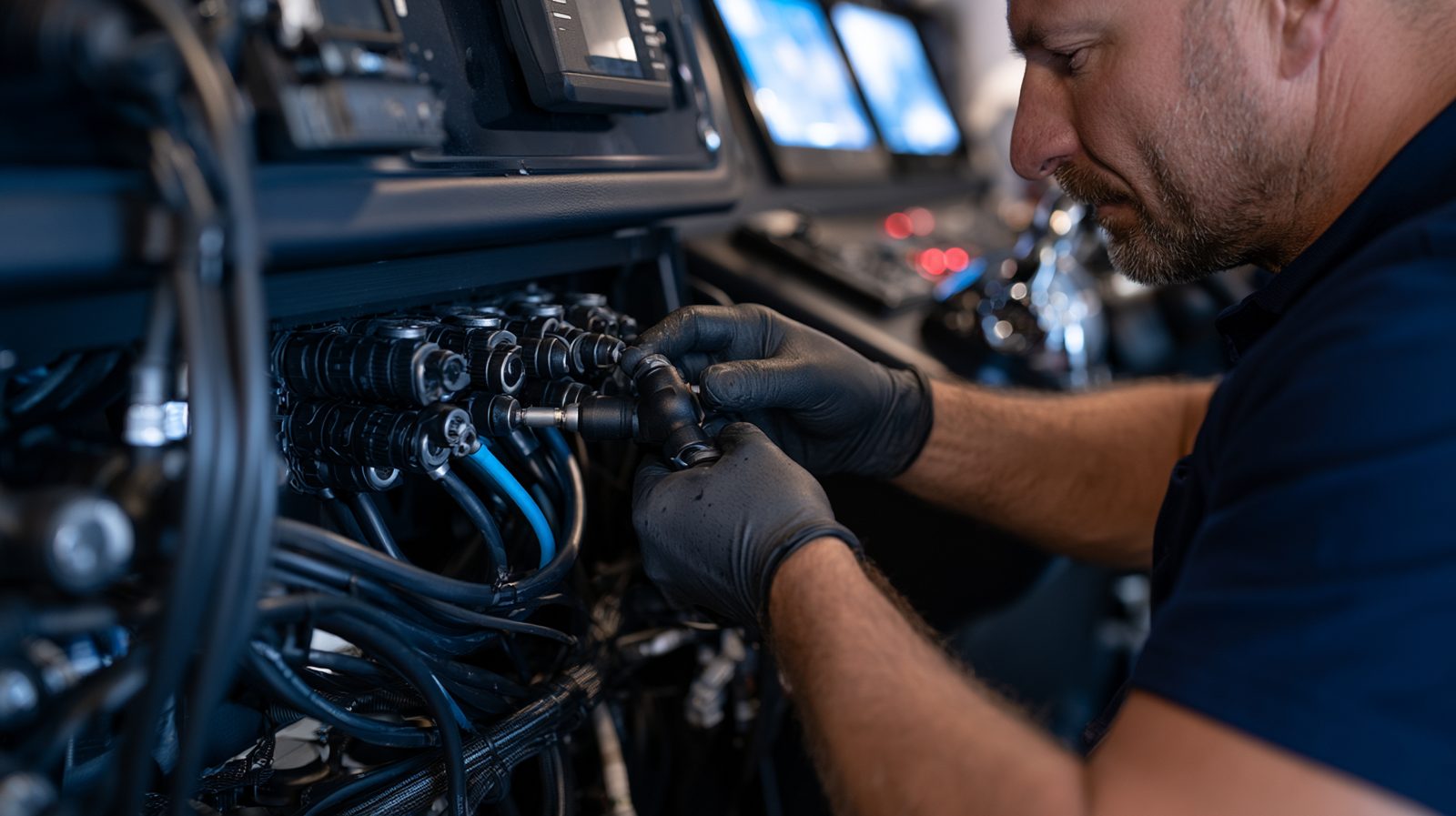
Physically, the installation always looks the same. A backbone runs through the vessel from the wheelhouse to the engine compartment. T-connectors tap into that backbone, one per device, each with a drop cable of limited length. At both ends of the backbone sits a 120 ohm terminating resistor. Without both terminators the bus will sometimes still work — badly, intermittently, dropping frames in a way that takes weeks to diagnose.
Three things come up on almost every job.
- Total drop cable length is capped. Adding improvised tees to squeeze in one more sensor eventually degrades the whole network.
- The bus is powered. The current budget has to be calculated; one more device is not always neutral.
- Every device claims an address. An address conflict shows up as an instrument that disappears from the display for no apparent reason.
None of this is trivia. Everything that follows depends on a clean bus. A badly terminated network leaves gaps in the record, and a record full of gaps supports no trend analysis at all.
PGNs are messages, not sensors
The bus carries standardised messages identified by a number: the PGN, or Parameter Group Number. A PGN is not a sensor and not a single value. It is an envelope holding several fields. That is the most common misunderstanding when people first work with N2K, and it has two practical consequences.
First, a parameter may not be published at all. If the engine has no fuel pressure sender, the corresponding field goes out marked "not available". The message arrives; the field is empty. Second, the fact that a PGN is on the wire says nothing about measurement quality. A float-type level sender in a fuel tank is still a float-type level sender, whatever protocol carries its reading.
Which NMEA 2000 PGNs matter for maintenance
A maintenance plan needs only a handful of PGNs. These are the ones that carry the substance, with their real contents.
| PGN | Standard name | Useful contents |
|---|---|---|
| 127488 | Engine Parameters, Rapid Update | Engine speed, boost pressure, tilt/trim position. Broadcast at a fast rate. |
| 127489 | Engine Parameters, Dynamic | Oil pressure, oil temperature, coolant temperature, fuel pressure and fuel rate, alternator potential, engine load and torque, total engine hours, status and alarm bits. |
| 127493 | Transmission Parameters, Dynamic | Gear engaged, gearbox oil pressure and temperature. |
| 127497 | Trip Fuel Consumption, Engine | Consumption over the current passage. |
| 127498 | Engine Parameters, Static | Rated engine speed, engine and software identification. |
| 127505 | Fluid Level | Fluid type (fuel, fresh water, black water, grey water, oil), level as a percentage, tank capacity. |
| 127508 | Battery Status | Battery voltage, current and temperature. |
| 127506 | DC Detailed Status | State of charge, estimated time remaining, ripple. |
| 129025 and 129026 | Position, Rapid Update / COG & SOG, Rapid Update | Position, course and speed over ground: the operational context of any reading. |
| 128259 and 128267 | Speed, Water Referenced / Water Depth | Speed through water and depth. |
Three clarifications matter more than the list itself.
Running hours live in PGN 127489, not in a dedicated message. They arrive in the same stream as the temperatures and pressures, which is good news: a single source feeds both the counter that drives the maintenance plan and the condition monitoring.
Engine speed lives in PGN 127488, not in 127489. That is the whole point of the rapid update versus dynamic split: engine speed changes fast and is broadcast often, temperatures move slowly and are broadcast less.
Alternator potential and battery bank voltage are not the same parameter. The voltage measured by the engine control unit comes up in 127489. The voltage of a battery bank measured by a shunt or a charger comes up in 127508, with state of charge in 127506 where it is available. Confusing the two means monitoring the wrong circuit.
One final caution that applies to the whole table: makers do not all expose the same thing. Many engines reach the bus through a manufacturer's own gateway, so you have to check case by case, with the bus connected and the engine running, which fields actually arrive populated. That is half a day alongside, and no datasheet substitutes for it.
Where NMEA 2000 fits, and where it stops
This has to be said plainly, because the promise is routinely oversold: NMEA 2000 stops where a commercial ship's engine room begins.
N2K was born for bridge electronics and modest propulsion. It is relevant, and often excellent, on:
- commercially operated leisure craft and yachts up to mid-size units;
- inshore fishing vessels and small fast craft;
- workboats: pilot boats, passenger tenders, training vessels, harbour service craft;
- any vessel whose main engines have an electronic control unit feeding a maker's gateway.
On a ferry, a research vessel, a CTV or an offshore wind SOV, the picture is different. High-output main engines, generator sets, separators and main switchboards do not speak NMEA 2000. The data comes from elsewhere.
- J1939 — the CAN protocol of the heavy truck and diesel industry, very widely used on medium-output electronically controlled engines. It is exactly what J1939-to-N2K gateways convert on mixed vessels.
- Modbus, RTU over RS-485 or TCP — the everyday language of PLCs, switchboards, drives, separators and generator sets.
- The vessel's alarm and monitoring system, which already concentrates the machinery points and normally offers an export interface.
The condition-based maintenance reasoning is identical in all three cases: a measured parameter, a threshold, a history, a work order. Only the transport layer changes. What matters to an owner is not to settle on a maintenance management tool that can read only one protocol. On a mixed fleet — a few workboats on N2K, two vessels whose machinery points leave the alarm system over Modbus — the unification has to happen in the CMMS, not in the wiring.
Gateway to cloud: building the data chain
The bus stays on board. For the data to serve a fleet maintenance plan, it has to leave the vessel. That is the job of the gateway: a unit tapped onto the backbone through a T-connector, listening to the PGNs and republishing them over TCP/IP to a server.
What to look for in a gateway
Rather than a brand, here are the characteristics worth checking before you buy. The list fits on one page and heads off most of the unpleasant surprises.
- NMEA 2000 certification. A certified unit respects the current budget, the isolation requirements and address management. That is what guarantees it will not upset the navigation instruments.
- Galvanic isolation between the bus and the unit's own power supply. On a steel or aluminium hull, that is what stops you injecting an earth loop into a navigation network.
- Listen-only capability. The gateway must be able to listen without ever transmitting on the bus. Any unit that writes to a navigation network is a risk that needs justifying.
- Local storage and replay. When the link drops, the unit must keep recording and push the time-stamped history up when connectivity returns. Without that, the data you lose is the data acquired at sea — precisely the data that matters.
- Time-stamping at source. Points must be dated on board rather than on arrival at the server, otherwise a replay after forty-eight hours offline produces a false history.
- Configurable filtering and sampling. Nobody needs position at ten hertz to do maintenance. Reducing at source reduces the satellite data bill.
- A documented output format, not encrypted by the manufacturer, otherwise you are locked into that box and its vendor.
- Power supply and ingress protection that match where the unit will really be fitted, which is rarely the dry cabinet shown on the drawing.
We deliberately do not name a preferred model here: the market moves, and the right choice depends mostly on the engine maker and the connectivity available on board. Those eight criteria, on the other hand, do not move.
Latency, bandwidth and onboard caching
A marine data chain is not a shoreside data chain. Three differences shape everything else.
The link drops. That is the norm, not the exception. A pilot boat runs out of cellular coverage, a netter works fifty miles out, an antenna loses lock in a hard turn. Any architecture that assumes a permanent link will produce gaps. Onboard caching is not a comfort feature: it is the component that decides whether your history is usable at all.
Bandwidth costs money. Pushing every raw frame off an N2K bus is several hundred megabytes per vessel per day. Pushing one-minute averages of fifteen parameters, plus threshold-crossing events, is a few megabytes. The second is enough for all of condition-based maintenance.
Useful latency depends on the use case. A drop in oil pressure has to be dealt with in seconds — and it already is, by the engine alarm, on board, with no server involved. A cloud feed is not there to replace machinery protection. It does something else: retain, compare, decide with a cool head. To follow a temperature drift over three weeks, one reading per minute is ample and hourly is often enough.
Put another way: immediate protection stays on board and stays hard-wired. The cloud serves maintenance, not machinery safety. Confusing the two leads to fragile architectures and disappointed expectations.
Automatic running hours change how the plan works
Of all the data on the bus, the most useful is not the most spectacular. It is the hour counter.
An engine maintenance plan is almost always counter-driven: oil change at 250 hours, valve clearances at 1,000, injectors at 3,000. As long as the counter is read by hand, three things happen. It gets read late, and the due date slips. It gets copied wrong, and one bad figure propagates through the whole history. Or it does not get read at all during a busy spell, and nobody ever fills the gap.
When the counter is fed automatically from PGN 127489, the task falls due on the real value, on the day it is reached. Smart Sailors hour counters drive the plan's tasks directly, and the work order is raised without anyone having to think about it. It is not spectacular. It is the change that produces the most effect in the first year.
The same mechanism applies to tanks. PGN 127505 feeds tank level monitoring, which lets you reconcile real consumption against running hours — the foundation of any serious fuel consumption monitoring.
A trustworthy counter is evidence in front of an inspector
There is a second, less frequently discussed reason to want an accurate hour counter: compliance.
When a class surveyor or a port state control officer opens your maintenance plan, they do not stop at confirming that a task exists. They check that it was carried out when it fell due. For a counter-driven task, that means proving two things: what the counter read on the date of execution, and that the reading was not entered after the fact to justify the job.
An automatic reading time-stamped at source answers that without argument. A handwritten notebook copied into a spreadsheet answers it badly, and that is exactly the sort of weakness that turns a routine visit into an observation. For vessels operating under an approved planned maintenance system, traceability of execution is not administrative comfort: it is the condition for keeping the approval. The same reasoning applies to the digital engine room logbook, whose running hours must agree with the plan's. Two counters that disagree, and the credibility of the whole file is up for debate.
From thresholds to work orders
Once the parameters are being collected and stored, the mechanism is simple: a rule, a threshold, a confirmation delay, an action.
The confirmation delay is the parameter everybody forgets. A temperature above a limit for one second is measurement noise or a corrupted frame. The same temperature held for thirty seconds is an event. Every useful rule therefore reads "parameter, comparison, threshold, for duration".
The table below is a starting framework. The values are illustrative examples, not settings. Real thresholds come out of the engine maker's documentation, are cross-checked against the existing machinery alarm settings, and are calibrated with the chief engineer's experience of that particular vessel. A turbocharged engine running at 88 degrees C nominal and a naturally aspirated one at 78 degrees C do not share a threshold, and nobody ashore can decide it for them.
| Parameter (source) | Example rule, to be calibrated | Action raised in the CMMS |
|---|---|---|
| Running hours (127489) | Plan interval reached | Planned work order "oil change and filters", normal priority, parts reserved |
| Coolant temperature (127489) | Above the maker's nominal, held for a duration you define | Warning-level alert, inspection work order on the cooling circuit |
| Oil pressure (127489) | Below the maker's minimum at service speed | Critical alert, immediate corrective work order, notification to the chief engineer |
| Oil temperature (127489) | Drift above the thirty-day average at comparable engine speed | Inspection work order, sample drawn for oil analysis |
| Battery bank voltage (127508) | Below the float threshold for several minutes | Work order "check charging circuit", high priority |
| Tank level (127505) | Operational low level set by the operator | Notification to the vessel, bunkering line added to port call preparation |
| Engine speed (127488) | Time spent above the continuous rating | Duty severity counter, review of plan intervals |
The last row deserves a comment. Counting hours is not always enough: a thousand hours idling on pilot standby and a thousand hours at full load do not wear an engine the same way. Cross-referencing running hours with time spent in each speed band gives far more accurate plan intervals. It becomes possible as soon as you store 127488 alongside 127489.
Once the work order exists, everything hangs on what reaches the crew. A work order sitting on a server achieves nothing. A work order available on a mobile device in the engine room, with the procedure and the part number attached, gets closed out. That is the link that decides whether the whole chain was worth building.
Why crews stop reading alerts
This is the point most projects underestimate, and it is the one that kills them.
An alert is only worth something if it is rare. A crew that receives four notifications a day for a fortnight over exceedances with no consequence stops reading them. Not out of negligence — out of attention economy. And on the day the real alert arrives, it drowns in the noise. This pattern has been recognised in machinery control rooms for a long time, and it reappears unchanged the moment you connect a cloud feed without discipline.
What generates noise, in the order it is usually encountered:
- thresholds copied from one vessel to another — what is nominal on a pilot boat is not nominal on a trawler;
- no confirmation delay, which turns every measurement spike into an event;
- no handling of transient states: an engine starting up has low oil pressure and cold coolant, and a rule that ignores engine speed and time since start will fire on every departure;
- no hysteresis: a value oscillating around the limit raises an alert on every crossing, so the return-to-normal level has to sit apart from the trigger level;
- no acknowledgement: an alert that cannot be acknowledged or annotated simply keeps coming back.
The method that works is dull but reliable. Start in observation only for four to six weeks, with no notifications at all, purely recording. Then look at the values actually reached in normal operation, set thresholds above that envelope, and switch on notifications for three or four parameters only. Add more later, one at a time. A fleet running alerts on oil pressure and coolant temperature alone, but whose crews act on every one, is far ahead of a fleet monitoring forty points that nobody looks at any more.
One last habit worth building: count alerts the way you count breakdowns. A dashboard showing how many alerts were raised, how many were acknowledged and how many led to an actual intervention tells you immediately whether the configuration is sound. That ratio belongs beside the conventional maintenance indicators.
A threshold alert is not trend analysis
It is worth being clear about what threshold monitoring gives you, and what it does not.
A threshold is retrospective. By the time the temperature crosses it, the problem is already there. You gain the time it takes to react, which is worth a great deal, but you have anticipated nothing.
A trend is prospective. It does not compare a value to a limit; it compares a value to its own history under equivalent conditions. The question is no longer "is the temperature above 95 degrees C" but "at 1,400 rpm with 18 degrees C sea water, is this engine running three degrees hotter than it did two months ago". Three degrees triggers no alarm at all. It is nonetheless the signal.
Trending imposes constraints that threshold monitoring does not:
- a long, unbroken history, which means onboard caching that genuinely works;
- normalisation for conditions — engine speed, load, sea water temperature, ambient temperature. Comparing readings taken at different engine speeds produces nothing but noise;
- a clean baseline, meaning a reference period during which you know the machinery was in good order;
- a record of interventions. A drop in temperature after a yard period is not a spontaneous improvement: it is the effect of cleaning the heat exchanger, and the history has to say so.
This is also where the bus reaches its limit. NMEA 2000 gives you slow, global parameters: temperature, pressure, speed, level. It says nothing about the condition of a bearing, a coupling imbalance, a shaft alignment fault or a hot spot in a switchboard. For that you need dedicated methods — vibration analysis and thermography — and oil analysis, which remains the best information-per-pound available on a marine diesel. Bus data is a continuous baseline you have already paid for. It does not replace those measurements: it tells you when to take them.
What this is actually worth
We are not going to publish a percentage reduction in breakdowns: those figures mean nothing outside the context of one specific fleet. The reasoning, on the other hand, holds, and anyone can rerun it with their own costs.
Take a main engine out of action. The real cost is almost never the part. It is an unplanned port call: the vessel is not working, the crew is still paid, a yard slot is chased at short notice, the part goes out on express freight, and on a chartered unit there is a day that will not be invoiced. Add those lines up for your own operation, once. The figure you get is your reference cost.
Now compare it with the other branch. A temperature drift picked up three weeks earlier is a prepared job: the vessel is alongside for its technical call anyway, the part is ordered on normal freight, the work happens between tides, nobody sleeps in a hotel. That is the difference between a job alongside and a tow.
The same reasoning applies to missed intervals, and it cuts both ways. An oil change done a hundred hours late shows up on no dashboard at all, until the day the oil analysis comes back loaded. And an oil change done a hundred hours early, repeated across eight vessels with two engines each, is a budget of oil, filters and labour spent for nothing. An accurate counter removes both errors.
Finally there is the cost that never appears in a budget: the time spent chasing information. How many hours a month does a superintendent spend emailing for readings the bus already produces continuously? That line exists in no operating account, and it is often the first one to disappear.
This shift is exactly what the move from corrective to condition-based maintenance describes: you do not remove the work, you choose when it happens.
Where to start
Projects like this fail in almost exactly the same way every time: everything gets connected, everything gets switched on, and the whole thing is abandoned two months later. The following order limits that risk.
- Check the bus before anything else. Terminators, voltage, drop lengths, address conflicts. Half a day alongside.
- Record what actually arrives. Connect a logger, list the PGNs present and the fields genuinely populated, engine running and engine stopped. You will then know what you can monitor, which is rarely what the brochure claims.
- Get the hour counter right first. One parameter only, but the one that drives the plan. It is the fastest and most durable gain: the planned maintenance schedule becomes accurate with no extra effort.
- Record without alerting for four to six weeks, to learn the vessel's normal envelope.
- Switch on three thresholds, not thirty. Oil pressure, coolant temperature, and a third parameter chosen with the chief engineer.
- Review at three months with the crew: how many alerts raised, how many were meaningful, how many work orders were genuinely closed out. Adjust, then widen.
- Roll out to the fleet only once one vessel works, keeping thresholds specific to each unit.
On a fishing fleet as much as on a professionally managed yacht, the limiting factor is never the bus technology. It is configuration discipline and the quality of crew feedback. NMEA 2000 supplies a continuous, reliable raw material you have already paid for. What you get out of it depends entirely on the rigour of the maintenance plan receiving it.
Connecting onboard data to the maintenance system is the next stage of an approach described in our maritime CMMS guide.


.png)


