

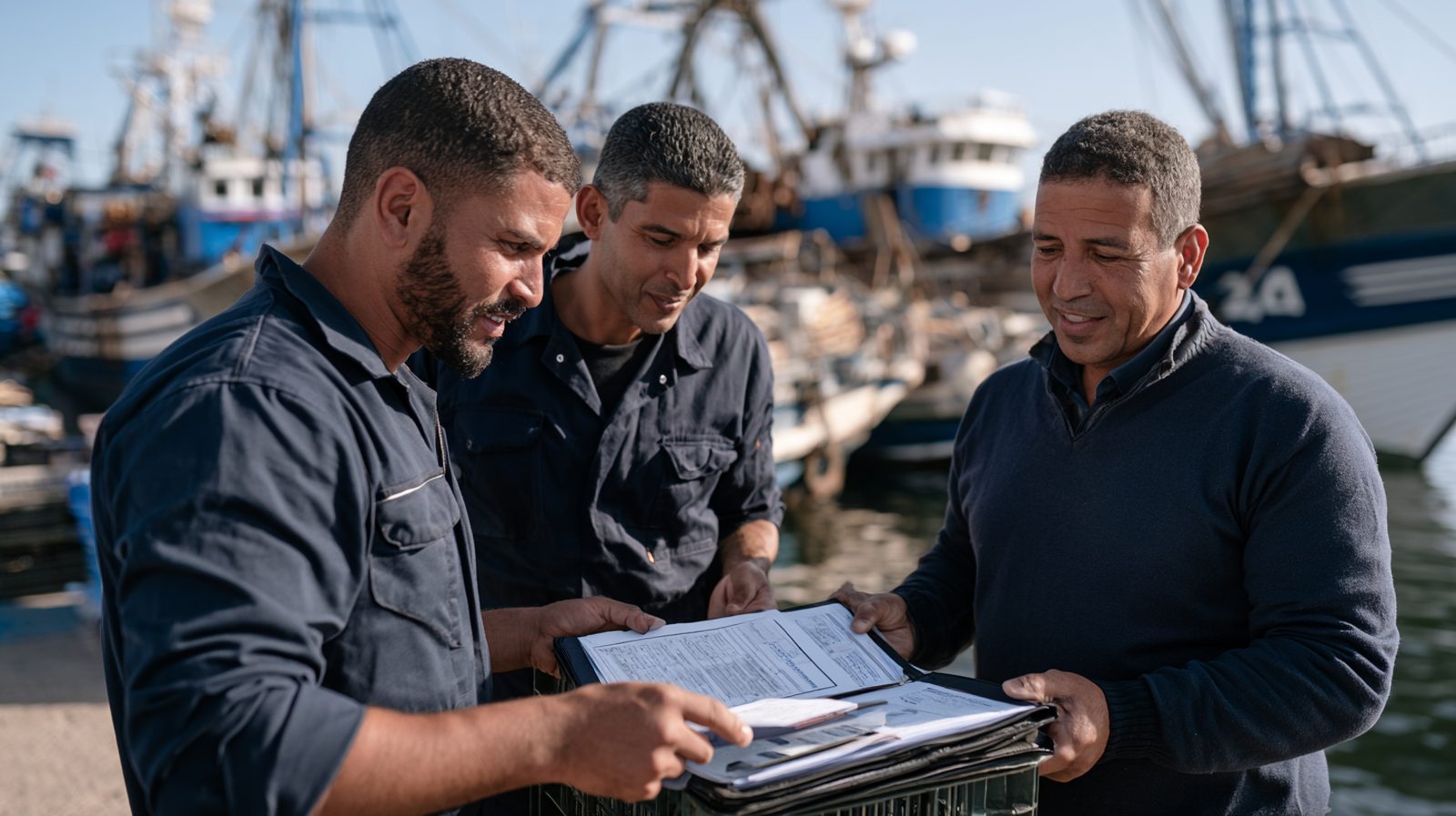


A Moroccan deep-sea trawler with an expired certificate does not leave the quay. That is not a theoretical risk. The navigation permit, the fishing licence and the crew's certificates of competency are all checked before departure, and any one of them is enough to stop a trip that is already crewed, iced and stored. For an owner running ten, twenty or fifty units, the difficulty is not knowing the rules. It is keeping a renewal calendar that never slips.
This article sets out what a fishing vessel under the Moroccan flag has to carry, which texts create those obligations, and how a fishing company actually organises the tracking. Legal references are given where they could be confirmed against two independent sources. Where they could not, that is stated plainly — it is better to call the délégation des pêches maritimes at the vessel's home port than to sail on a confident-sounding mistake.
What counts as deep-sea fishing in Morocco
The Moroccan fleet is split into three administrative segments, and that split drives which documents apply. The FAO country fishery profile for the Kingdom of Morocco defines the deep-sea segment (pêche hauturière) as vessels above 150 gross registered tons fitted with on-board freezing; coastal vessels sit below that threshold, and the artisanal segment covers small boats under 2 GRT. A Policy Center for the New South study of the Moroccan fisheries system describes the same deep-sea fleet as steel vessels over 24 metres, mostly cephalopod and shrimp trawlers, with some pelagic trawlers and a handful of reefers.
The two sources use slightly different criteria — tonnage in one case, length and hull material in the other. That reflects an administrative reality: the segment is read off the licence and the mode of operation, not off a single line on the tonnage certificate.
Why the deep-sea segment is the hard case
- Trip length. A freezer cephalopod trawler stays out for weeks. A certificate that expires mid-trip cannot be renewed on the way.
- Freezing plant on board. That means refrigeration machinery, pressure equipment and refrigerants — surveys that simply do not exist on a small boat.
- Operating area. A deep-sea vessel may work far from its home port, or beyond the exclusive economic zone, which changes the operating title required.
- Crew size. More functions on board means more certificates of competency to match against the actual manning.
Long trips, heavy machinery, a full crew list: that combination is why poor document control is most expensive in this segment. The same mechanics apply across any fishing fleet running maintenance software, where safety, availability and cost all turn on the same renewal dates.
Two separate bodies of law, two administrations
A common mistake is to look for a single Moroccan text covering deep-sea fishing. There isn't one. Two sets of rules run in parallel, with two different administrations behind them.
The vessel: the maritime commercial code
The dahir of 31 March 1919 forming the Code de commerce maritime, still in force and amended several times, governs the ship's nationality, tonnage, ship's papers and safety certificates. The text is also available as a PDF. It is this code that requires every Moroccan ship to carry a certificate of nationality, a clearance document (congé), a crew register, a health patent, a navigation permit and its logbooks. The competent administration sits with the merchant marine department, working through the quartiers maritimes.
The activity: the maritime fishing regulation
The dahir bearing law no. 1-73-255 of 23 November 1973, amended notably by law no. 39-03 of 2004 and then by law no. 15-12 of 12 May 2014 on preventing and combating illegal, unreported and unregulated fishing, governs the right to fish: licence, authorisation, catch declaration, satellite tracking, control and penalties. The competent administration is the maritime fisheries department, working through délégations des pêches maritimes along the coast.
A vessel whose safety file is immaculate but whose licence has lapsed does not fish. A vessel with a valid licence and an expired navigation permit does not sail. Both chains have to hold at the same time.
What the international conventions do — and do not — cover
One stubborn misconception is worth killing here. Most of the major IMO conventions were written for merchant ships and explicitly exclude fishing vessels. The FAO summary of international conventions relevant to safety at sea in fishing is unambiguous: apart from Chapter V, SOLAS does not apply to fishing vessels, and neither does the 1978 STCW Convention. The 1966 International Convention on Load Lines also excludes fishing vessels, in its Article 5.
Purpose-built fishing instruments do exist, but they have moved slowly. STCW-F 1995 covers skippers and watchkeeping officers on vessels of 24 metres and over, and chief engineers on vessels of 750 kW and above. The 2012 Cape Town Agreement, which implements the 1993 Torremolinos Protocol, is not yet in force: Argentina's accession in February 2026 crossed the required threshold and entry into force is now announced for 2027, applying to fishing vessels of 24 metres and above.
The practical consequence is that what binds a Moroccan deep-sea vessel today is national law first. International instruments shape the Moroccan texts; they do not replace them. We were unable to confirm against two independent sources exactly where Morocco stands on STCW-F and on the Cape Town Agreement. If your operation depends on that point, verify it with the administration.

Ship certificates and papers
Registration, nationality, tonnage
Everything starts with entry in the national register and issue of the certificate of nationality, which evidences the right to fly the Moroccan flag. Tonnage measurement is carried out by the navigation service, which issues the certificate; the net tonnage is engraved on the vessel. These are the root documents of the whole file: a tonnage error propagates into regulatory thresholds, fleet segment and fees.
Worth knowing for investment projects: acquiring, building or converting a Moroccan fishing vessel requires prior authorisation. Decree no. 2-20-147 of 27 March 2020, made under law no. 59-14, sets the procedure — an administrative and technical file lodged with the délégation des pêches maritimes, defined processing deadlines, and filing windows for replacing vessels lost, exported or scrapped.
Navigation permit and safety certificates
The navigation permit is the base title: without it, no departure. It is issued after the safety survey. Moroccan maritime safety commissions are chaired by the head of the quartier maritime. There is a central commission, which approves plans and type-approves equipment; commissioning survey commissions, which inspect the hull in dry dock before a vessel enters service under the Moroccan flag; and annual survey commissions, which decide on renewal or withdrawal of the certificate.
On validity, Article 34 of the maritime commercial code sets one year for these titles, except the safety certificate for outfitting equipment, valid two years. That reading comes from a specialist secondary source; have it confirmed by your quartier maritime for your own vessel, since tonnage and trading area can change the applicable regime.
On life-saving and communication equipment, decree no. 2-18-103 lays down the general rules Moroccan fishing vessels must satisfy. Its subject matter is confirmed by two sources: the government council report relayed by Maritime News Maroc and the feature in LesEco.ma on the new safety rules for fishing vessels. The latter cites an arrêté no. 507.20 of 5 February 2020 setting equipment lists — inflatable lifejackets, liferafts, radar reflector, pyrotechnics — and a requirement to keep an evacuation drill record above 24 metres reference length. Those details rest on a single source. Treat them as a lead to confirm, not as an enforceable standard.
Fishing licence and authorisation beyond the EEZ
Two distinct operating titles coexist. The fishing licence conditions the right to fish inside the Moroccan exclusive fishing zone; it is issued by the government authority responsible for maritime fisheries and covers the calendar year. The fishing authorisation applies to Moroccan-flagged vessels working beyond the exclusive economic zone; its duration cannot exceed the rights granted by the third state or the regional fisheries management organisation concerned. The regime comes from the 1973 dahir and is detailed by decree no. 2-17-456 of 15 March 2018.
One point of current relevance for owners who used to operate under the European framework: the implementing protocol of the EU–Morocco Sustainable Fisheries Partnership Agreement expired on 17 July 2023, and on 4 October 2024 the Court of Justice of the European Union annulled the decision approving the agreement, in joined cases C-778/21 P and C-798/21 P. Do not build a compliance plan on the assumption that an EU–Morocco framework is in force without checking the position at the time you file.
| Document | Issued by | Indicative validity | What it blocks if missing |
|---|---|---|---|
| Certificate of nationality | Navigation service / quartier maritime | Permanent, updated on change | Flag entitlement cannot be evidenced |
| Congé (clearance) | Maritime authority | One year for multiple voyages (Art. 25) | Departure not authorised |
| Tonnage certificate | Navigation service | Permanent, redone after modification | Thresholds and fees unsupported |
| Navigation permit | Maritime authority, after safety survey | One year (Art. 34, to be confirmed) | Departure prohibited |
| Safety certificate for outfitting equipment | Maritime authority | Two years (Art. 34, to be confirmed) | Life-saving equipment not validated |
| Freeboard certificate | Recognised classification society | Periodic survey cycle | Loading limit unsupported |
| Radio safety certificate | Maritime authority | One year (Art. 34, to be confirmed) | Radiocommunication installation not validated |
| Fishing licence | Maritime fisheries department | Calendar year, annual renewal | No right to fish in the exclusive fishing zone |
| Fishing authorisation beyond the EEZ | Maritime fisheries department | Aligned on third-state or RFMO rights | No access to the intended area |
| Crew register (rôle d'équipage) | Quartier maritime | Updated at every crew movement | Irregular engagement, control stops the vessel |
| Health patent | Health authority | Per health regulations | Port call may be refused |
| Deck and engine logbooks | Kept on board | Continuous | Operating history cannot be demonstrated |
Treat this table as a working template, not as an enforceable list. The exact file depends on tonnage, area and licence type. That is precisely the kind of matrix you configure once in a central certificate register, rather than rebuilding it vessel by vessel before every survey.
Crew documents
Certificates of competency: the text most people cite is the wrong one
Many sources point to decree no. 2-17-788 of 2 October 2018 on the seafaring profession. For fishing, that is wrong: the decree covers merchant ships and expressly excludes fishing vessels. The relevant text is decree no. 2-17-556 of 8 December 2017, setting the list of certificates and the conditions required to hold command and officer functions on board maritime fishing vessels, indexed by ECOLEX and FAOLEX. It lists certificates by vessel category — decked, semi-decked, undecked — sets conditions for exercising command, provides for time-limited derogatory engagement authorisations, and establishes a central register of certificates and equivalences.
The logic is the familiar one: enforcement turns on the match between the certificates actually held on board and the manning the vessel is required to carry. Replace a chief engineer at short notice with someone holding an insufficient certificate and the vessel is non-compliant, however immaculate the ship's own papers are. That is exactly the problem covered in our article on crew certificate management.
Basic safety training
According to Moroccan press reporting, an arrêté no. 723-24 published in May 2025, repealing an arrêté no. 3287-20 of December 2020, makes entry on a fishing vessel's crew register conditional on producing a basic maritime safety training certificate issued by an approved establishment: the Institut supérieur des pêches maritimes, the maritime fisheries technology institutes, and maritime vocational qualification centres. We found only one source for that arrêté. The principle of mandatory basic training is consistent with the rest of the framework, but confirm the exact references with the délégation des pêches maritimes at your home port before writing an internal procedure around it.
Medical fitness: a recent and very practical text
Decree no. 2-23-303 of 18 September 2023, published in Bulletin officiel no. 7236 of 5 October 2023, sets the physical fitness and medical examination conditions for fishers. It is grounded in Article 167 bis of the maritime commercial code and in ILO Convention no. 188 on Work in Fishing. The key points:
- a medical examination on engagement, then annually for serving fishers;
- every six months for those under 18;
- the certificate is issued by a public-sector doctor or by an expert doctor listed on the roll of judicial experts;
- where a fisher is found unfit, a counter-examination may be requested before the provincial medical commission within ten working days;
- and, most usefully, a rule aimed squarely at long trips: the certificate remains valid until the vessel returns to port, even if it expires during the fishing voyage.
Read that last provision carefully. It applies to the medical fitness of fishers. We found nothing extending the same mechanism to the ship's own safety certificates. Do not assume a navigation permit expiring at sea is covered the same way.

Surveys, inspections and enforcement
Before departure
The pre-departure document check is where it all happens. It covers the validity of the ship's certificates, the fishing licence or authorisation, and the match between the crew register and the required certificates. Three separate chains, three administrations, one verdict.
At sea
At-sea inspections of Moroccan fishing vessels are carried out by the Royal Navy and the Royal Gendarmerie, supported by sworn officers of the maritime fisheries department. Law no. 15-12 gives those officers broad inspection powers: access to every compartment, to the catch, to the fishing gear and to equipment, and the right to take statements from the crew.
In port
Landing controls cross-check identification and weighing against the catch declaration data, in the auction halls operated by the Office national des pêches. Licence validity is re-verified at each step of the chain. An owner who cannot produce a complete vessel file — certificates, competency documents, logbooks — within minutes loses time exactly where it costs most.
Abroad
A Moroccan vessel calling outside the Kingdom is exposed to port State control. Morocco is a member of the Mediterranean Memorandum of Understanding on Port State Control, alongside Algeria, Croatia, Cyprus, Egypt, Israel, Jordan, Lebanon, Malta, Tunisia and Türkiye. The mechanics of an inspection, the typical deficiencies and the way to prepare the file are the same as for a merchant ship; we cover them in our guide on how to avoid a port State control detention.
Catch traceability, fishing logbooks and VMS
The fight against illegal, unreported and unregulated fishing has added a third documentary chain, separate from safety and from operating rights: traceability.
The catch declaration is the first link. It identifies the vessel, the fishing activity, the catch and the parties involved, and it underpins traceability all the way downstream to export. Satellite tracking is provided for by Article 28 of law no. 15-12, which targets continuous position monitoring of Moroccan-flagged vessels in order to detect IUU practices. VMS has been rolled out across the national coastal and deep-sea fleet, according to Morocco's presentation on combating IUU fishing to the General Fisheries Commission for the Mediterranean and to a COMHAFAT note on the Moroccan monitoring, control and surveillance system. That second source also describes an electronic reporting system (ERS) and a catch certification application used from landing through to export.
The programme is still moving. The state secretariat for maritime fisheries has launched an international tender for two applications: one for information management, catch certification and traceability, the other for electronic reporting and vessel activity monitoring. At the time of writing these systems are in procurement, not in service. Any announcement of full digitalisation should be checked before it is written into a shipboard procedure.
For the owner, the practical consequence is that the fishing logbook stops being a notebook and becomes a file document. The same standard of record-keeping applies to the ship's own books — see our article on the digital engine room logbook and audits.
Running a renewal calendar across a fleet
Here is what a year of operation looks like from a superintendent's desk. The table is a template: real dates depend on each certificate's anniversary.
| Lead time | Item falling due | Who is involved | What has to be ready |
|---|---|---|---|
| D-120 | Annual safety survey | Survey commission, quartier maritime | Yard window, spares, test reports for deck machinery |
| D-90 | Fishing licence renewal | Délégation des pêches maritimes | Up-to-date vessel file, fees, consistency between area and gear |
| D-90 | Dry-docking and hull survey | Yard, classification society | Dock booking, job specification, anodes and cathodic protection |
| D-60 | Officers' certificates falling due | Owner, maritime authority | Revalidations started, reliefs identified |
| D-45 | Crew medical examinations | Approved doctors | Scheduled in port, not mid-trip |
| D-30 | Radio certificate, life-saving appliances | Approved workshops, maritime authority | Liferaft servicing, beacon checks, pyrotechnics expiry dates |
| D-15 | Full file cross-check | Owner | Certificates, competencies, crew register, fishing logbook, VMS working |
| D-0 | Departure | Port authority | File producible in one go, copies on board and ashore |
The workload argument is easy to make yourself, and it beats any statistic. Count the certificates on a single vessel: roughly a dozen ship documents, plus one medical certificate and at least one certificate of competency or training per crew member. On a twenty-hand deep-sea vessel that is already around fifty renewal dates. Multiply by the number of units, then add that those dates are neither synchronised nor on the same cycle — one year here, two years there, longer for some revalidations. A spreadsheet survives that for about a year; it breaks at the first crew change that nobody logs. We set out why in our comparison of spreadsheets versus a maritime CMMS.
The traps that tie a vessel up
The certificate that expires mid-trip
This is trap number one for deep-sea operators. A three to six week campaign will comfortably cross an anniversary date. The tolerance rule exists for fishers' medical fitness, as set out above; do not assume it exists for the ship's certificates. The fix is organisational: line renewals up with technical calls, and refuse to sail with a certificate expiring before the planned return date plus a margin.
The document left ashore
Paper files are still the norm in many fishing companies. An original sent to the office for an administrative step and never returned, and the inspection stalls on a document that actually exists. The answer is dual availability: original on board, digital copy accessible to crew and to head office, with a unique reference per vessel and per certificate. The principle is the one described in our article on mandatory certificates and classification surveys.
Changing area, gear or mode of operation
Switching from cephalopods to pelagics, changing area, or moving from fishing inside the exclusive fishing zone to fishing beyond it is not an operational adjustment: it is a change of title. Licence and authorisation are not interchangeable, and the safety file can move too if the gear changes.
Undeclared conversion work
Hull modification, hold refurbishment or a repower affects tonnage, freeboard and sometimes the fleet segment. Decree no. 2-20-147 requires prior authorisation for construction, acquisition and conversion. Conversion work done informally, without a file, puts both the safety certificate and the operating title at risk.
The broken chain at engagement
A crew member signed on at short notice without a valid medical certificate, or without the certificate matching the function, puts the whole vessel in default. The crew register is the control point: it has to reflect the real crew, up to date, with the supporting documents behind it.
What maintenance software actually changes
A maritime CMMS does not replace the délégation des pêches maritimes or the quartier maritime. What it changes is how the owner holds position between surveys.
One register per vessel. Every certificate is a record: issuer, issue date, expiry date, cycle, scanned attachment. The same register carries crew competency and medical certificates. The certificates module and the crew module share the same renewal logic.
Alerts tied to the operating cycle, not to the expiry date. Warning thirty days before a navigation permit expires is useless if the vessel is at sea for six weeks. The alert that matters fires before departure, not before expiry.
A link between the certificate and the technical work behind it. A radio safety certificate assumes a maintained installation; a hull survey assumes a planned dry-docking. Attaching the certificate to the preventive maintenance job plan that supports it stops you from discovering during the survey that the equipment was never serviced.
A file you can produce in one go. During an inspection, the surveyor does not want explanations. He wants the documents, in order, with dates. Producing a vessel's full status in minutes — valid certificates, upcoming renewals, competencies of the crew actually on board, survey history — changes the tone of an inspection.
A fleet view. Across twenty vessels the question stops being "is this ship compliant?" and becomes "which ships will not be compliant in sixty days, and which of those are alongside then?". That is a planning question, not a compliance question.
Points to confirm before you commit
Three points need confirmation from the délégation des pêches maritimes at your home port and from the competent quartier maritime, because we could not establish them on two independent sources:
- the exact validity periods of the safety certificates for your vessel, given its tonnage and trading area;
- the reference and content of the arrêté on basic safety training required for entry on the crew register;
- whether any extension applies when the vessel is abroad or at sea on the expiry date, and how far it goes. We met this claim in unsourced material and could not confirm it; do not plan around it.
The rest — the architecture of the texts, the separation between the safety chain, the operating chain and the traceability chain, the cross-checking logic of enforcement — is stable. That architecture is what a workable document control system is built on. If you want to see how it plays out on a real fleet, our team supports fishing owners in France, the Maghreb and West Africa: let's talk about your fleet.
Managing documents connects with the rest of the vessel's upkeep, which we describe in the complete maritime CMMS guide.


.png)


