




An expired certificate makes no noise. It raises no bridge alarm and appears on no watch report. It surfaces at the worst possible moment: at the gangway, when a Port State Control officer lines up the crew list against the Minimum Safe Manning Document.
Crew certificate management is one of the few compliance areas where the error is binary. A medical certificate that expired twenty-four hours ago cannot be argued away: the seafarer is no longer deemed fit, the ship is no longer manned as required, and accountability travels straight back to the company, the shipowner and the Designated Person Ashore.
This article sets out a practical method: map what has to be tracked for each seafarer, find where the system breaks, understand what an expired document costs in a real inspection, and build alerting that makes forgetting structurally impossible.
Mapping a seafarer's document file
A watchkeeping officer does not hold one certificate. They hold a stack, issued by different authorities, with different validity periods, where some documents condition the validity of others.
STCW certificates and flag State endorsements
The STCW Convention 1978, as amended — notably by the 2010 Manila amendments — sets the standards of training, certification and watchkeeping. A seafarer typically holds a Certificate of Competency (CoC) matching their function and level of responsibility, plus Certificates of Proficiency (CoP) for specific tasks.
Two points are consistently underestimated. First, these certificates are issued for a limited period — five years in common administration practice — and revalidation depends on qualifying seagoing service and, where required, refresher training. Second, a certificate issued by one State does not automatically apply under another flag: a flag State endorsement is required under STCW Regulation I/10. In practice it is the endorsement, not the CoC, that is most often missing at an inspection.
Regulation I/10 provides one relief valve: a flag Administration may allow a seafarer to serve for up to three months holding a valid certificate issued by another Party, provided documentary proof that an endorsement application has been submitted is readily available on board. An email buried in a personal inbox counts for nothing in front of a PSCO.
Basic and specialised training
Basic training — personal survival techniques, fire prevention and fire fighting, elementary first aid, personal safety and social responsibilities — falls under STCW Code section A-VI/1. Since the Manila amendments, survival and fire-fighting competence must be refreshed every five years in practice, with documentary evidence.
Depending on rank and ship type, add advanced fire fighting, survival craft and rescue boats, medical care, security training, tanker training, Polar Code and passenger ship familiarisation. GMDSS operator certification follows its own regime.
Medical fitness certificate
STCW Regulation I/9 and MLC 2006 Regulation 1.2 converge: no seafarer works on board without a valid medical fitness certificate issued by a duly qualified, professionally independent practitioner. Maximum validity is two years (one year under 18); colour vision is reassessed at intervals not exceeding six years, and on international voyages the certificate must be available in English.
Two flexibilities are frequently misapplied. If a certificate expires during a voyage, it remains in force until the next port where a recognised practitioner is available, capped at three months. In urgent cases the authority may permit up to three months of work where the seafarer holds a recently expired certificate. Safety nets, not management methods.
Names vary by flag — the UK ENG1, issued by MCA-approved doctors with a maximum validity of two years, is the best-known example in yachting — but the logic and the equivalence arrangements between flags are the same.
Seafarer Employment Agreement and social documents
MLC 2006 requires a Seafarer's Employment Agreement (SEA) signed by the seafarer and the shipowner, an original kept by each. Around it sit the financial security certificates for abandonment and for death or long-term disability, the Declaration of Maritime Labour Compliance and the ship's Maritime Labour Certificate.
The 2022 amendments to MLC 2006, in force since 23 December 2024, strengthened several areas touching the seafarer's file: financial protection under recruitment and placement services, repatriation of abandoned seafarers and of the remains of deceased seafarers, prompt disembarkation for serious injury or illness, internet access on board at reasonable cost, appropriately sized personal protective equipment, and recording and annual reporting of seafarer deaths to the ILO.
Passports, visas and company documents
The last block usually sits in another department and is poorly synchronised: passport, Seafarer's Identity Document, visas, vaccinations, work permits. Then company documents — ship familiarisation, permits to work, ISM designations, in-house training — rarely statutory, but the first thing an internal auditor asks for. Our maritime glossary covers the acronyms.
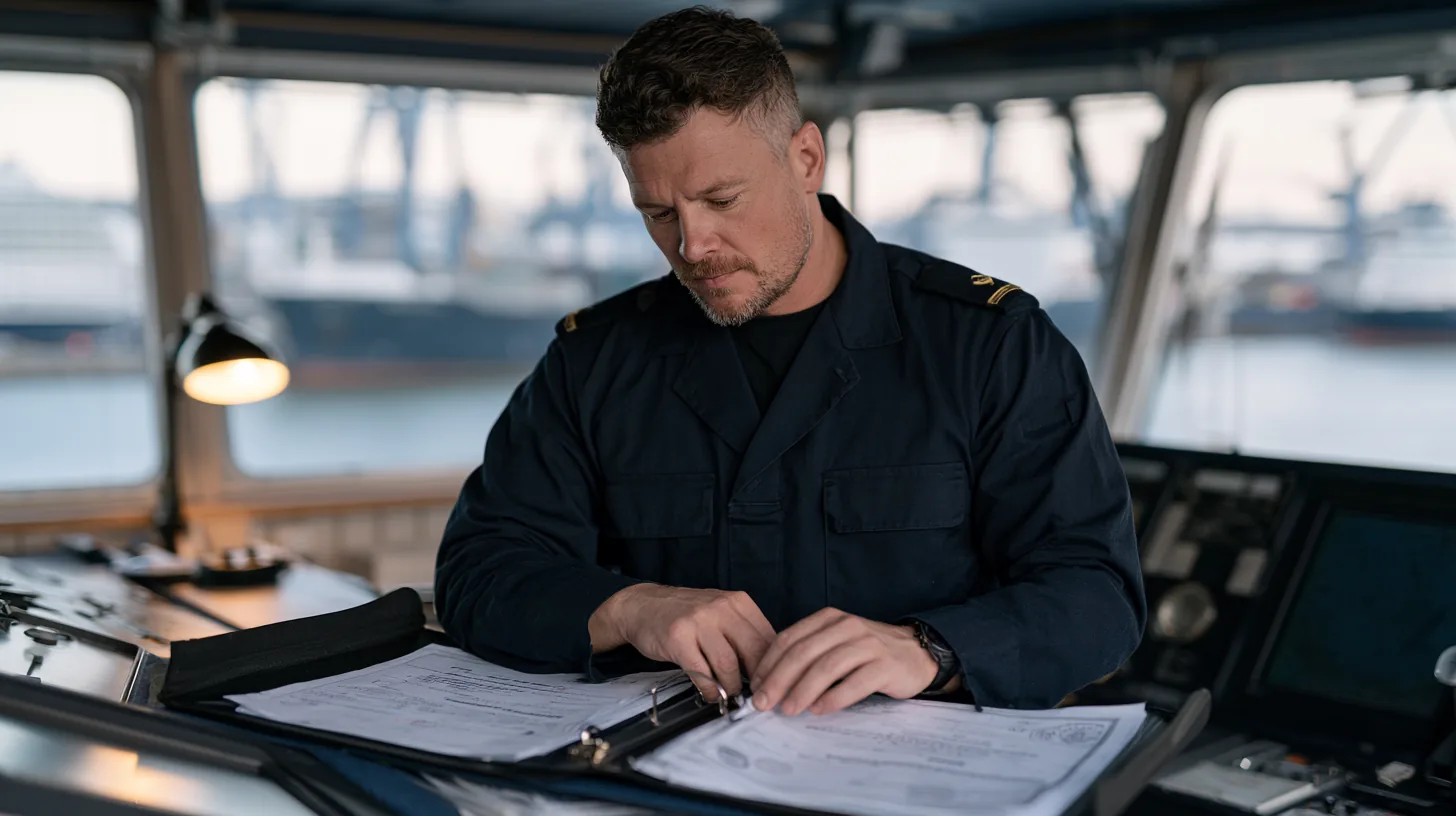
The manning matrix: one expired certificate, one detained ship
From manning document to crew list
The Minimum Safe Manning Document issued by the flag State sets the number and qualification of seafarers required for a given ship and trade. It is a condition of compliance, not an indicative target: if an engineer officer in charge of a watch loses their endorsement, a statutory position is left unfilled.
Hence the manning matrix: cross the positions required by the manning document and the Safety Management System against the certificates actually held by the seafarers on the roster. Every cell must be covered by a certificate valid for the whole rotation.
Expiry mid-rotation
A chief officer joins on the 3rd for a ten-week tour; their advanced fire fighting certificate expires on the 28th. On joining day everything is green. Halfway through the tour the ship is non-compliant and nobody on board knows, because the check was done once.
The operational rule: a certificate must be valid at the planned end-of-rotation date, plus a buffer for delayed reliefs. In exposed trades — missed port calls, waiting at anchor, drydocking that overruns — three to four weeks is realistic. On short passenger or port-service rotations the buffer can be smaller if the check is more frequent.
What happens in a PSC inspection or ISM audit
Port State Control
Inspectors check certificates of competency and proficiency with flag State endorsements, medical certificates, training records, the Minimum Safe Manning Document, the table of shipboard working arrangements and records of hours of rest. The Paris MoU publishes dedicated guidance on certification and manning under STCW, MLC and SOLAS precisely because this area concentrates recurring deficiencies.
The step to detention turns on severity: a missing or expired certificate, manning below the manning document, no qualified watchkeeper, or an unqualified person holding a position. A detention means hours or days alongside, port and delay costs, flying in a replacement, and a public record in the regional MoU database that worsens the ship's risk profile.
ISM audit and major non-conformity
An ISM auditor looks for a system failure, not just a missing document. One expired certificate may be raised as an observation; no documented tracking procedure, no named responsible person and no evidence of a pre-joining check leads to a non-conformity — or a major one where safety is affected. See our articles on the ISM Code and how it applies and the ISM Code and CMMS.
Reference table: document, issuer, typical validity, consequence
| Document | Issued by | Typical validity | Consequence if expired |
|---|---|---|---|
| STCW Certificate of Competency | Issuing State | 5 years, revalidation subject to seagoing service | Seafarer unqualified; manning position unfilled; classic detention ground |
| Flag State endorsement | Flag State | Aligned with the CoC, never beyond it | Not valid under that flag; 3-month tolerance only with proof of application |
| Basic training (A-VI/1) | Approved training centre | Survival and fire fighting refreshed every 5 years | PSC deficiency; cannot be assigned muster duties; ISM non-conformity |
| Specialised training (advanced fire fighting, survival craft, security, tankers) | Approved training centre | By module; five-year updating is common | Function not covered; trading restriction by ship type |
| Medical fitness certificate (ENG1 or equivalent) | Approved medical practitioner | 2 years max; 1 year under 18; colour vision up to 6 years | Seafarer deemed unfit; extension to next port only, capped at 3 months |
| Seafarer's Employment Agreement | Shipowner | Duration of engagement | MLC 2006 deficiency; wage claims and on-board complaints |
| Financial security (abandonment, death, disability) | Insurer or provider | Usually annual | Major MLC deficiency; certificate must be posted on board |
| Passport, Seafarer's Identity Document, visas | National authorities | Variable; visas often 6 to 12 months | Crew change blocked, transit refused, re-routing costs |
| Ship familiarisation and company permits | Company and Master | Every joining, or per SMS procedure | ISM non-conformity; liability exposure after an incident |
| Records of hours of work and rest | On board, endorsed by Master and seafarer | Daily, copy given to the seafarer | MLC deficiency; presumption of fatigue after a casualty |
Exact periods depend on the flag, the ship type and the trading area: confirm them with your Administration, then configure them once. A flag-specific example is described in our article on certificates for deep-sea fishing vessels.
The recommended process: five building blocks
1. A single register
The primary failure factor is not forgetfulness, it is fragmentation: a spreadsheet in crewing, a shared folder in HR, scans on the Master's laptop, originals in a folder on board. The register must hold, per seafarer and per document: type, number, issuer, issue date, expiry date, scanned file and assigned vessel.
2. Alerts at 90, 60 and 30 days
A single alert the day before expiry is useless: course availability, medical appointments and above all endorsement processing are measured in weeks.
- D-90 — planning. The training slot or medical appointment is placed on the rotation plan, not on the seafarer's leave.
- D-60 — commitment. Booking confirmed, application submitted, proof of submission filed in the register.
- D-30 — escalation. If the document is still not issued, the case goes to the superintendent and the DPA, and a replacement is evaluated.
For flag State endorsements and consular visas, an additional threshold at D-120 is safer.
3. A named responsible person
“Crewing handles it” is not a process. Every document type needs an owner: crewing for certificates, endorsements and SEAs; the ship for familiarisation and hours records; the DPA for arbitration. That naming is exactly what an ISM auditor looks for.
4. Filed documentary evidence
A valid document you cannot produce is, in an inspection, an absent document. Every certificate should be scanned, time-stamped, linked to the seafarer and available offline from the ship — decisive at sea or in a port with no usable connectivity.
5. A formal pre-joining check
The highest-return block: a signed checklist before every joining that verifies validity at the planned end-of-rotation date. Five minutes per seafarer against the cost of a detention. The same systematic logic applies to work safety, covered in our article on permits, lockout/tagout and competence.
Rotations and crew changes: where the system breaks
Companies rarely lose control in steady state. They lose it on a last-minute replacement: a seafarer is landed for medical reasons, a reliever is found within forty-eight hours and joins holding a valid CoC but no endorsement for that flag. The ship sails non-compliant.
Three safeguards contain the risk. Build a pool of pre-qualified relievers already tracked in the register, with flag endorsements obtained in advance for critical functions. Block any assignment that fails the register's automatic check — the block must be technical, not cultural. And record every derogation: its regulatory basis and end date belong in the register with their own alert.
Certificates and hours of rest: two sides of one file
MLC 2006 Standard A2.3 requires either maximum hours of work — 14 in any 24-hour period and 72 in any seven-day period — or minimum hours of rest — 10 in any 24-hour period and 77 in any seven-day period. Rest may be split into no more than two periods, one of at least six hours, with no more than fourteen hours between them. The table of shipboard working arrangements is posted in the working language and in English, and the seafarer receives an endorsed copy of their records.
The link with certification is direct. When a statutory position goes unfilled because a certificate lapsed, workload shifts to the rest of the crew, rest hour records drift, and you end up with two correlated deficiencies: non-compliant manning and a rest hours breach. After a casualty, that correlation is exactly what an investigator looks for. Tracking both in one system, with the discipline applied to the ship's logbook, is a safety decision.
Seafarers' personal data: what data protection requires
A certificate register is personal data processing — and, for medical certificates, health data. Under the GDPR and equivalent regimes, three principles shape the design.
- Minimisation. Record fitness status and expiry date, not the medical reason or restrictions beyond what the assignment strictly requires.
- Storage limitation. Keep the file live for the duration of the employment relationship, then move it to intermediate archiving until the applicable limitation periods expire. Live database and archive must be technically separated, and the archive actually purged.
- Data subject rights. Seafarers have rights of access, rectification and information on purposes: they must be able to obtain copies of what the company holds on them, which requires a clean per-person export.
Add role-based access control, access logging, and written data processing terms with the manning agencies that feed the register.
Crew and Certificates modules: how it is implemented
Smart Sailors is a maritime CMMS / ERP designed by seafarers, developed in Marseille and deployed on more than 700 vessels. Two of the twelve platform modules address this subject directly.
The Crew module holds each seafarer's file: identity, rank, assignment, rotations, certificates and scanned documents. It carries the manning matrix and lets you verify, before confirming an assignment, that every manning document position is filled by a seafarer whose certificates remain valid until the end of the rotation.
The Certificates module provides the expiry engine: dates, configurable alerts, assigned owner, attached evidence and renewal history. It handles ship and crew certificates in the same logic, so a class survey or PSC visit never uncovers two systems that ignore each other. The Dashboard module shows the next sixty days of expiries across the fleet.
Everything runs on the mobile app, which works offline — essential when a document must be produced with no connectivity. Pricing ranges from EUR 10 per vessel per month for leisure craft to EUR 100 (Premium) and EUR 150 (Enterprise), with a 30-day free trial.
Key takeaway — A certificate must be valid not on joining day, but at the planned end-of-rotation date plus a buffer for delayed reliefs. A single register, three alert thresholds (D-90, D-60, D-30), a named owner per document type and scanned evidence available offline cover most of the risk. The three-month regulatory tolerances are safety nets, not management methods.
FAQ
How long is an STCW certificate and its flag State endorsement valid?
STCW certificates of competency and proficiency are issued for a limited period, commonly five years, and revalidation depends on qualifying seagoing service and, in some cases, refresher training. The endorsement cannot extend beyond the certificate it relates to, so check both dates.
Can a seafarer work with an expired medical certificate?
In principle, no. Two framed flexibilities exist: if it expires during a voyage it remains in force until the next port where a recognised practitioner is available, capped at three months; and in urgent cases the authority may permit up to three months of work where the seafarer holds a recently expired certificate. Both must be documented and alerted.
What triggers a detention during a PSC inspection?
A missing or expired certificate, manning below the Minimum Safe Manning Document, no qualified watchkeeper, or an unqualified person holding a position — plus failures in rest hour records. The detention is also published in the regional MoU database and worsens the ship's risk profile.
What did the 2022 MLC amendments change?
In force since 23 December 2024, they strengthen financial protection under recruitment and placement services, repatriation of abandoned seafarers and of the remains of deceased seafarers, prompt disembarkation for serious injury or illness, internet access on board at reasonable cost, appropriately sized personal protective equipment, and annual reporting of seafarer deaths to the ILO.
How do you reconcile a digital register with data protection law?
Through data minimisation, role-based access, a clear separation between live database and intermediate archiving with actual purging once limitation periods expire, and a mechanism allowing seafarers to exercise access and rectification rights. Manning agencies feeding the register must be bound by written data processing terms.
Is a spreadsheet enough?
For one or two vessels with a stable crew, yes. It becomes risky as soon as several people edit it, supporting documents live elsewhere and rotations stack up: alerts then depend on one person's vigilance. The tipping point observed in practice is around three vessels or thirty tracked seafarers.
Conclusion
Crew documentary compliance is not decided at the inspection. It is decided ninety days earlier, when someone does — or does not — book a medical appointment and submit an endorsement application. A single register, three alert thresholds, a named owner, filed evidence and a pre-joining check aligned to the rotation turn a detention risk into routine.
Want to see how the Crew and Certificates modules behave on your own fleet? Book a demo or start your 30-day free trial. You can also reach us through our contact page or at contact@smartsailors.net.
Beyond certificates, access control matters too: the roles and permissions module ensures every seafarer and shore manager sees only what concerns them, a point auditors regularly check. Vessel and crew certificates are handled in the same system, whose workings our maritime CMMS guide describes.


.png)


