

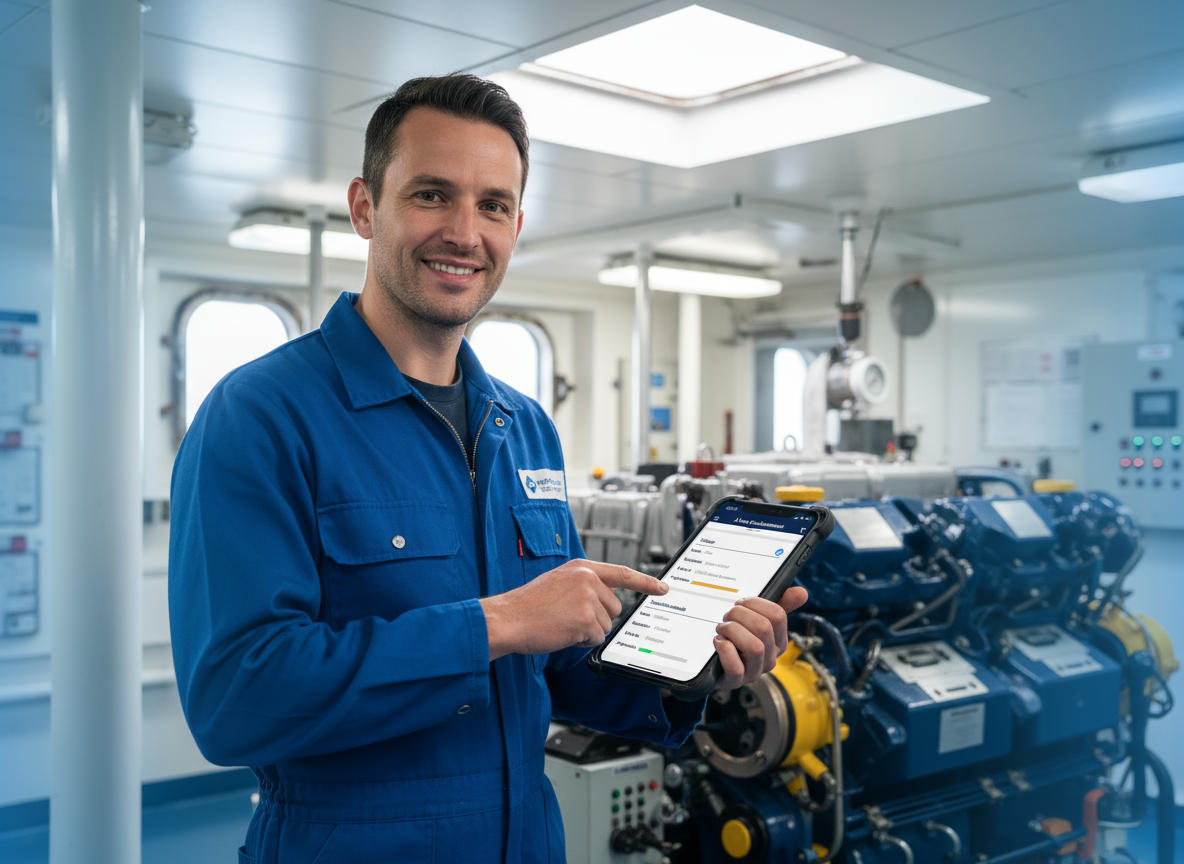


A sea water cooling pump that fails in a workshop means two hours of downtime and a supplier who calls round in the afternoon. The same pump failing 300 miles offshore means a reduction in speed, a rescheduled port call, a charterer to notify and a part to be brought in through a freight forwarder. It is this asymmetry that makes the corrective versus condition-based debate far more clear-cut at sea than ashore.
The question, then, is not whether you should move to condition-based maintenance, but when and on which equipment. The answer comes down to one equation: the switch becomes compelling as soon as the annual cost of breakdowns on a critical asset exceeds the cost of monitoring it. This guide gives you the criteria for working out that threshold, the technologies that can be applied on board, and what classification societies are prepared to credit in return.
What corrective maintenance really costs on a vessel
Corrective maintenance looks cheap: no sensors, no subscription, no training. That simplicity hides a cost structure the shore-based industrial world never has to deal with.
The direct, visible costs
- Parts ordered as an emergency, with express freight and price premiums that often add 30 to 50 % to the list price.
- Transit and customs clearance: getting a part to a foreign port sometimes costs more than the part itself.
- External intervention: an equipment maker's technician travelling out to a port call, billed at emergency rates.
- Crew overtime, called on outside the plan and often at the end of a tour of duty.
The indirect costs, which decide the matter
- A port call delayed or missed: the logistics chain does not catch up, and neither does the charterer.
- Contractual penalties for unavailability, common on offshore service or regular liner contracts.
- Towage or assistance if propulsion is lost, an item whose order of magnitude dwarfs everything else.
- Port State control detention if the failure affects safety equipment, with a public listing that follows the vessel for years.
- Risk to people: a sudden rupture in the engine room exposes the crew to flying debris, burns or a pressurised leak.
The gap between the two columns is the heart of the matter. A bearing failure on a generator can cost €15,000 to repair and ten times that in operational consequences if it happens at the wrong point in the rotation.
The prerequisite: documenting the real cost
Before investing in any monitoring at all, your CMMS must record the full cost of every corrective job: parts, labour, downtime, operational consequences. It is this history, and nothing else, that will let you show your management that letting equipment fail costs more than watching it. Without those figures, the debate stays a matter of opinion.
The principle: acting within the P-F interval
Condition-based maintenance rests on a simple idea: act when the actual condition of the equipment shows measurable degradation, but before the function is lost.
It differs from planned maintenance, which replaces parts at fixed intervals even when they are still serviceable. Condition-based work is driven by data: vibration signature, temperature, particles in the oil, ultrasound signal.
The P-F curve
This is the central concept, and it is worth understanding before buying a single sensor.
- Point P — degradation begins and becomes detectable by measurement, while the equipment is still running normally.
- The P-F interval — the window in which you can plan. It runs from a few days to several months depending on the failure mode and the technology used.
- Point F — functional failure. The equipment no longer performs its function.
The whole value of condition-based maintenance lies in the length of that interval. On board, it has to be longer than the time remaining until the next port call, otherwise detection achieves nothing: knowing that a bearing will give way in 48 hours when six days of sea passage remain leaves you no options. That is the major difference with a shore site, where you can always stop and intervene.
The measurement chain on board
Three building blocks make it up. First collection, through permanent sensors on the most critical components, or through a periodic measurement round with a portable instrument — an approach that is more than sufficient for most fleets. Then transfer to the CMMS: it has to work offline and synchronise at the port call, otherwise nothing will ever come off the vessel. Finally processing: the CMMS compares the reading with the thresholds, raises the work order and keeps the history.
Two threshold levels are enough in practice. The alert threshold flags degradation: the job is planned for the next technical port call. The danger threshold signals imminent failure: you act as soon as possible, reduce speed or switch to the redundant unit.
Which equipment to monitor
Not every asset deserves to be monitored. Instrumenting an emergency pump that runs ten hours a year makes no economic sense. Condition-based maintenance is reserved for critical equipment, precisely what chapter 10.3 of the ISM Code points to: equipment whose sudden failure may result in a hazardous situation.
Three questions are enough to decide. Does a failure put safety or the environment at stake? Is the equipment without redundancy, or does losing it force a reduction in speed? Does the full cost of one breakdown comfortably exceed a year of monitoring? Two answers of “yes” out of three, and the asset is a candidate.
| Equipment | Why it is critical | Suitable technology |
|---|---|---|
| Main engine | Loss of propulsion, towage, missed port call | Oil analysis, vibration analysis, exhaust temperatures per cylinder |
| Generators | Blackout, loss of safety auxiliaries | Vibration analysis, oil analysis, switchboard thermography |
| Sea water cooling pumps | Cascading engine overheating, forced stoppage | Vibration analysis, ultrasound on the bearings |
| Steering gear | Safety equipment, a classic ground for detention | Hydraulic oil analysis, thermography, ultrasound |
| Starting air compressors | No way of restarting the main engine | Vibration analysis, leak ultrasound |
| Shaft line and gearbox | Long repair, immobilisation in drydocking | Oil analysis, vibration analysis, alignment check |
| Deck hydraulics and winches | Operations blocked on fishing and service vessels | Oil analysis, thermography, ultrasound |
| Main switchboards | Fire risk, loss of distribution | Infrared thermography |
This ranking comes before everything else. Our method for building a planned maintenance plan sets out the criticality approach behind it.

The four technologies you can use on board
| Technology | What it detects | Typical P-F interval | Implementation on board |
|---|---|---|---|
| Oil analysis | Metal wear, water or fuel contamination, oxidation, additive depletion | Long — several weeks to several months | The simplest: one sample, one shipment at the port call, one report. No equipment needed on board. |
| Vibration analysis | Imbalance, misalignment, bearing wear, mechanical looseness | Medium — a few weeks | Portable instrument and a periodic round. Calls for genuine training in interpretation. |
| Infrared thermography | Electrical hot spots, loose connections, insulation faults, bearings running hot | Short to medium | Portable camera, quarterly rounds. Quick to pick up. |
| Ultrasound | Air and steam leaks, electrical arcing, lubrication faults | Short | Light instrument, usable while running. Good cost-benefit ratio to start with. |
For a fleet starting out, the order of adoption is almost always the same: oil analysis first, because it needs no equipment on board and its P-F interval is the longest; then thermography, inexpensive and quick to master; vibration analysis after that, which gives the finest diagnosis but demands real competence.
Training decides the outcome
A sensor with nobody able to interpret the reading is worth nothing. This is the most frequent breaking point in these projects. Allow several days of training per engineer officer on vibration analysis, and above all train the reliefs as well as the incumbents: on a vessel, the person you trained signs off after two months. It is also why readings must live in the CMMS and not in a personal notebook — keeping a digital engine room logbook answers exactly this need for continuity.
What classification societies are prepared to credit
This is the argument many shipowners overlook. Within an approved planned maintenance system agreed with the classification society, condition readings can be used to credit certain machinery surveys in place of systematic opening-up. In practice, rigorous monitoring can shorten a survey and avoid needless dismantling.
The conditions vary from one society to another and always assume a documented file: dated measurements, justified thresholds, trends retained, qualified personnel. Speak to your classification society before building your programme: the cost avoided on surveys sometimes weighs as much as the cost avoided on breakdowns.
Putting figures on the move: an example across four vessels
The switch is justified when this inequality holds: annual cost of corrective breakdowns ≥ annual cost of monitoring and of the anticipated work it triggers.
Here is a deliberately conservative example, for a fleet operator with four vessels. The amounts are illustrative: redo the calculation on your own records.
| Current situation — corrective | Assumption | Annual cost |
|---|---|---|
| Unanticipated breakdowns on critical components | 2 a year across the fleet, at €63,000 each (€18,000 of repair and emergency parts, €45,000 of operational consequences) | €126,000 |
| Moving to condition-based maintenance | Assumption | Annual cost |
|---|---|---|
| Vibration measurement instrument | €9,000 written off over 5 years | €1,800 |
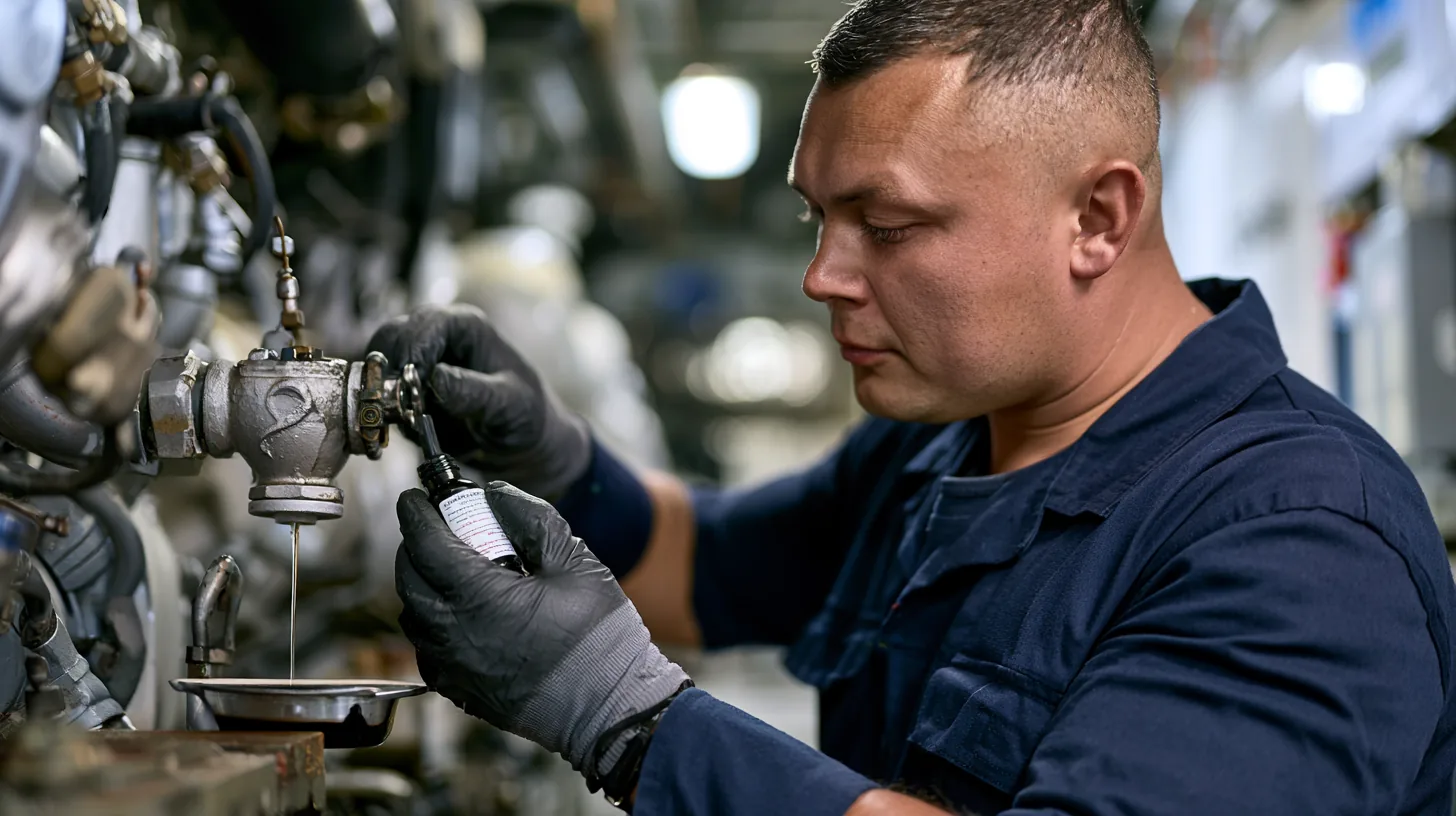
| Laboratory oil analyses | 4 vessels × 4 samples × €120 | €1,920 |
| Thermography campaign | One a year across the fleet | €2,500 |
| Training for the engineer officers | €3,500 written off over 3 years | €1,200 |
| Crew time spent on the measurement rounds | 60 hours at €55 per loaded hour | €3,300 |
| Anticipated work triggered by the alerts | Replacements planned at a port call rather than done as an emergency | €12,000 |
| Total | around €22,700 |
The gap is of the order of €100,000 a year across four vessels, for an initial investment of €12,500. Even halving the breakdown assumption, the equation stays comfortably favourable — and that puts no value at all on the detention risk avoided or on the survey credits obtained from the classification society.
The MTBF warning signal
A mean time between failures of less than six months on a critical component should trigger the review immediately. It means your teams spend more time repairing than operating, and that the accumulated corrective work already exceeds, without your having measured it, the cost of structured monitoring.
What you should measure next
The return shows up in four indicators, to be tracked in the CMMS by comparing before and after. The orders of magnitude below are those commonly quoted in the industry; your real gain will depend above all on your starting point.
- MTBF on the monitored components, which should improve as sudden breakdowns disappear.
- The share of corrective maintenance hours in the total, which falls mechanically once the work is planned.
- The value of stock tied up: anticipating lets you order ahead and cut dormant safety spares, a subject covered in our guide to spare parts management at sea.
- Component service life, which lengthens when you avoid sudden ruptures and the collateral damage they cause.
Where condition-based maintenance sits in a fleet operator's maturity
| Corrective | Condition-based | |
|---|---|---|
| Trigger | The failure once it has happened | A threshold crossed in the CMMS |
| Planning | Impossible — everything is an emergency | Possible — aligned with the port call windows |
| Costs | High and unpredictable | Moderate and budgeted |
| Procurement | Express freight, premiums, customs | Ordered ahead, delivered at the port call |
| Technology required | None | Measuring equipment, CMMS, training |
| Relationship with classification | Endured | Negotiable within an approved PMS |
| Stance of the technical team | Firefighter | Steering reliability |
The classic progression runs from corrective to planned maintenance, then on to condition-based. Condition-based is the stage where the technical department stops being subjected to breakdowns and starts steering availability — and it is the most profitable of the three jumps. We set this scale in its wider context in the complete guide to marine CMMS.
Does your most expensive asset deserve to be monitored?
Take the equipment that has cost you the most in breakdowns over the past two years and answer these five questions. They are enough to settle it.
- Does a sudden failure put the safety of people or the environment at stake?
- Is the equipment without redundancy, or does losing it force a reduction in speed?
- How many breakdowns has it suffered over the past twelve months?
- What was the full cost of the last one — parts, labour, port call, commercial consequences?
- Does that cost exceed what you would spend on a year of monitoring?
If the answer to the last question is yes, you have your first pilot. Start with a single piece of equipment, on a single vessel, with the simplest technology. A project that starts small and delivers a measurable result within six months then spreads across the fleet on its own.
In summary
Moving to condition-based maintenance is not a technology choice but an economic decision. As soon as the annual cost of breakdowns on a critical component exceeds the cost of monitoring it, the question is settled. At sea, that threshold is reached far sooner than ashore, because a failure there does not cost hours of downtime but a port call, a freight forwarder and sometimes a detention.
The readings still have to come off the vessel, be retained and trigger something. That is the role of a marine CMMS: collecting the measurement on board even without a connection, comparing it with the thresholds, generating the work order and keeping the trend over several years. Smart Sailors is designed in Marseille by seafarers and deployed on more than 700 vessels. Request a demonstration on your own equipment, or take a look at our plans.


.png)


